
Best Flooring Options for Pets
Muddy paws at the back door. A water bowl that splashes every time your dog drinks. Claws clicking down the hallway. And the accident you find an hour later.
Pets put more demands on a floor than most flooring guides admit. And pet owners are hardly a niche. 95 million U.S. households own at least one pet, according to the American Pet Products Association’s 2026 State of the Industry report.
There’s no single best floor for pets. A puppy still learning house-training needs something different from a 12-year-old Lab that struggles to stand up. The right choice depends on what your pet does to a floor and how each material handles it.
Key Takeaways
- No floor is pet-proof. The best floor resists the specific damage your pet causes.
- For frequent accidents, porcelain tile and rigid core LVP offer the strongest moisture protection.
- For real wood with dogs, densified hardwood tests on par with rigid-core vinyl and laminate in dog-scratch testing.
- Laminate resists scratches well, but only waterproof laminate belongs in a home with pets.
- For senior pets, traction and comfort matter more than hardness.
- Clean accidents right away on any floor. Waterproof planks still have seams.
- Textured, low-gloss, mid-tone floors hide everyday pet wear best.
Is There Such a Thing as Pet-Proof Flooring?
No. But some floors come close for specific problems.
Even pet-proof flooring has limits. A large, active dog with untrimmed nails can mark almost any surface. A puddle left for a full workday can seep past almost any seam.
The better question is which damage matters most in your home. Pet owners weigh six things:
- Scratch resistance: claws, running, and play
- Moisture protection: accidents, water bowls, and wet paws
- Traction: grip for running dogs and older pets
- Comfort: warmth, cushioning, and noise
- Cleaning: hair, dander, dirt, and odor
- Longevity and repair: how long the floor lasts and whether damage can be fixed
A floor that excels at one can fail at another. Porcelain tile shrugs off claws and accidents, but it can be slippery and hard on aging joints. Traditional laminate resists scratches, but one missed accident can swell its core.
Pet Flooring Comparison
No floor wins every column. Each one solves a different set of pet problems.
| Flooring | Scratches | Accidents | Traction | Comfort | Cleaning | Longevity and Repair |
| Solid hardwood | Fair; softer species mark easily | Poor; wood absorbs moisture | Good with a matte, textured finish | Warm, natural feel | Easy | Can be sanded and refinished many times |
| Engineered hardwood | Fair to good; depends on wood species and finish | Poor to fair; waterproof versions available | Good with a matte, textured finish | Warm, natural feel | Easy | Can be refinished; limited by veneer thickness |
| Densified hardwood | Very good; on par with rigid core and laminate in dog scratch testing | Good; resists topical liquids up to 8 hours | Good with a textured finish | Warm, natural feel | Easy; antimicrobial topcoat | Lifetime limited residential warranty from Robbins |
| Traditional laminate | Very good | Poor; core swells when wet | Fair; smooth surfaces can be slippery | Hard; can be noisy | Easy | Damaged planks must be replaced |
| Waterproof laminate | Very good | Good within the rated time | Fair to good with texture | Hard; can be noisy | Easy | Damaged planks must be replaced |
| Rigid core LVP | Very good | Excellent; won’t swell or buckle | Good with low-gloss texture | Attached pad cushions and quiets claws | Easy | Lifetime limited residential warranty from Robbins |
| Porcelain tile | Excellent | Excellent; grout needs sealing | Varies; polished tile can be slippery | Hard and cold | Easy; grout needs attention | Very long-lasting; cracked tiles replaced |
Ratings describe typical performance for each category. Specific products vary, so check the product’s specifications and warranty before you buy.
Flooring Options for Pet Owners
Choosing flooring for a home with pets means balancing durability, moisture protection, comfort, and appearance. Each flooring material has strengths and limitations, and the best choice depends on your pets’ size, age, activity level, and habits.
Here’s how the most popular flooring options compare and where each makes the most sense.
Solid Hardwood
Solid hardwood brings warmth and character. You can sand and refinish it many times over its life. That makes surface scratches fixable, not permanent.
Moisture is the bigger risk. Urine seeping between boards can stain the wood and cause it to cup. Softer species like pine or cherry also show claw marks quickly.
Solid hardwood works best for calm, house-trained pets. If you choose it, pick a harder species such as hickory or maple, a matte finish, and a textured surface.
Engineered Hardwood
Engineered hardwood puts a real wood veneer over a layered plywood core. That construction makes it more dimensionally stable than solid wood as humidity changes.
Scratch resistance depends on the species and the factory finish. A durable, low-gloss finish and a wire-brushed texture help hide everyday wear.
For households that need more moisture protection, Robbins® offers HydroGuard® waterproof engineered hardwood. It pairs a sealed hardwood surface with waterproof performance layers.
Take a closer look at how engineered hardwood compares with solid hardwood.
Densified Hardwood
Densified hardwood is the newest answer to an old question: can you have real wood floors with dogs?
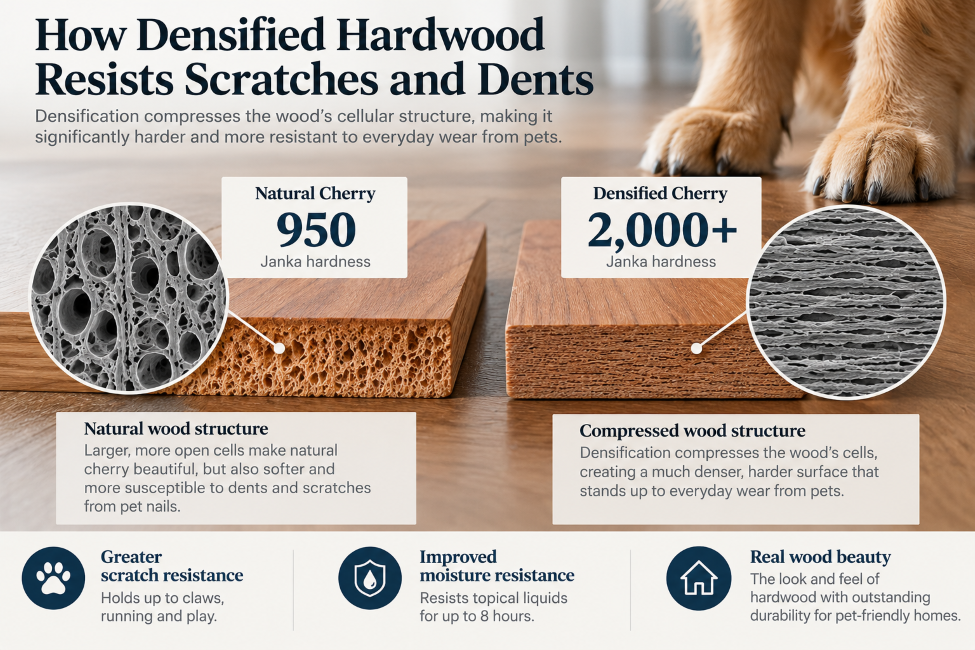
For example, Robbins Timber Legends™ uses ArmorWood™ Densified Wood Technology. AHF’s proprietary technology uses heat and pressure to compress the wood’s natural cell structure, with no fillers, plastics, or harsh chemicals. The result is 100% real wood that is much harder than its original species.
It comes in six species: pine, ash, cherry, walnut, maple, and red maple. For example, consider popular cherry flooring. In its natural state, cherry has a Janka Rating of 950. Once densified or hardened, that rating jumps to over 2000, more than doubling its hardness. For comparison, hickory, one of the hardest domestic hardwood flooring species, has a Janka rating of 1820.
What Densified Hardwood Means to Pet Owners
The test results matter most for pet owners:
- Scratches: In dog-scratch testing, Timber Legends performed on par with rigid-core vinyl and laminate, and better than traditional solid and engineered hardwood. It’s 4X more scratch-resistant than traditional engineered hardwood.
- Dents: In ASTM D2394 testing, a 2-inch weighted ball is dropped from 60 inches. Timber Legends is 6X more dent-resistant than traditional engineered hardwood.
- Accidents: Its warranty covers spills and pet accidents for up to 8 hours. It resists permanent urine staining when you clean up accidents immediately.
- Hygiene: A Cleantivity™ antimicrobial topcoat helps guard against everyday germs and helps prevent mold and mildew that could damage the floor.
- Longevity: It carries a limited lifetime residential warranty.
AHF’s densified wood has also proven itself under commercial traffic. At Per Diem restaurant in Lititz, Pennsylvania, the owner says the floor still looks as good as the day it was installed after about 50,000 guests in a year.
Hardened wood flooring is tougher, not indestructible. Large, active dogs with untrimmed nails can still mark it. Learn more by reading Hardened Wood Flooring – Designed for Real Life.
“A dog’s nail puts a lot of force on a very small point. Ordinary wood gives way because its cells are full of air. Densifying the wood closes those cells, so the surface pushes back instead of denting.”
— Travis Bjorkman, Principal Scientist, Wood, AHF
Laminate: Only If It’s Waterproof
Laminate’s strength is its surface. A hard, protective wear layer gives it excellent scratch resistance, which is why many pet owners consider it.
Its weakness is underneath. Traditional laminate has a wood-fiber core. When urine gets through the seams, that core absorbs it, can swell, and may not recover. A floor that shrugs off claws can be ruined by one missed accident.
That’s why only waterproof laminate belongs on a pet owner’s list. Before you buy, check three things:
- How long the floor is rated to resist standing liquid
- Whether the warranty covers pet accidents specifically
- Whether the surface is textured enough to give paws some grip
Laminate is also a hard surface. It can be louder underfoot than vinyl with an attached pad.
Rigid Core LVP
Rigid core LVP is the choice most pet owners hear about first, and for good reason. It’s waterproof, scratch-resistant, and easy to clean.
Robbins Daybreak™, for instance, features a high-density polymer core (HDPC®) for best-in-class indent resistance. That matters with large dogs and the furniture they bump into.
- Scratch protection: Diamond 10® Technology sits over a 20 mil wear layer (Select) or 22 mil wear layer (Preferred). The technology delivers scratch-, scuff-, and stain-resistant performance used in commercial flooring applications.
- Accidents: The planks won’t swell, buckle, or lose integrity when wet. Daybreak’s pet-friendly warranty covers stains from dog and cat soiling for the warranty period.
- Comfort: A 1 mm attached pad adds cushioning and helps quiet the click of claws.
- Flexibility: It needs no acclimation and handles temperatures from 0°F to 200°F, so it works in sunrooms where pets like to lounge. It installs on any level of the home.
- Warranty: Lifetime limited residential.
No vinyl floor is scratch-proof, and warranties typically don’t cover scratches. Waterproof planks also won’t stop standing water from reaching the subfloor.
Take a closer look at how LVP compares to engineered hardwood.
Porcelain Tile
Porcelain is dense, hard, and highly moisture-resistant. Claws generally won’t scratch it, and you can wipe off accidents.
Grout is the weak point. It’s more porous than the tile, so it needs sealing and regular cleaning to keep odors from settling in. Large-format tile, such as Robbins’ 24-by-48-inch English Isle™ collection, means fewer grout lines to maintain.
Tile has two drawbacks for pets. Polished tile can be slippery, especially when wet, so choose a matte or textured finish. It’s also hard and cold, which older pets with sore joints may notice. Rugs in resting areas help.
What Happens When Your Pet Has an Accident?
Most floors survive the accident itself. Damage comes from time and where the liquid goes. Learn how to remove wood floor stains.
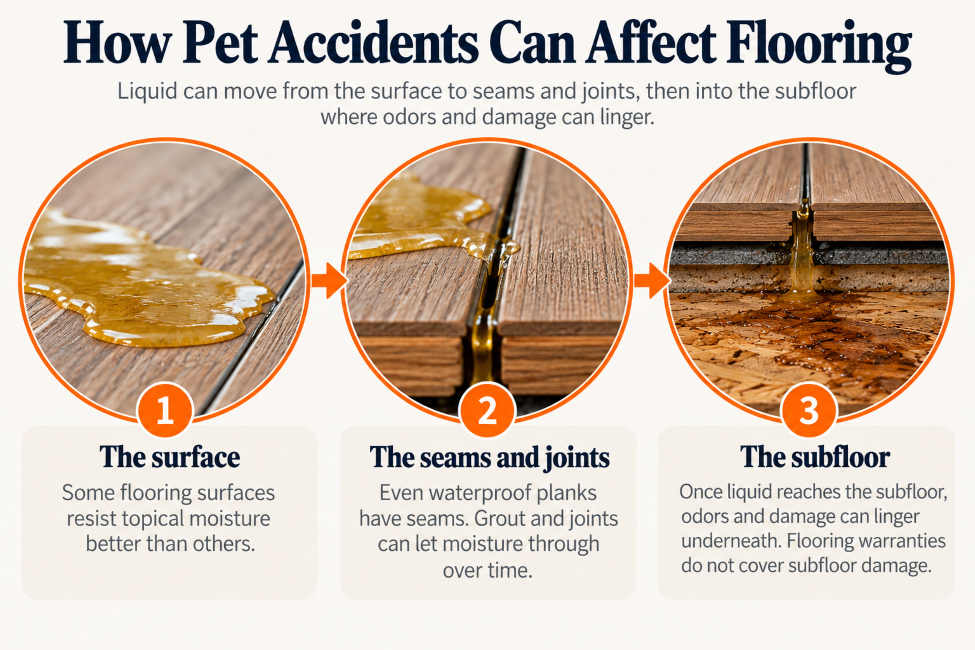
Think of a floor in three layers:
- The surface. Waterproof planks, densified wood, and porcelain resist liquid on top. Traditional hardwood and laminate don’t.
- The seams and grout. Even a waterproof plank has joints. If liquid sits long enough, it can work its way into the seams, and grout can absorb it.
- The subfloor. Once liquid reaches the subfloor, the problem is no longer the flooring. No floor’s warranty covers damage underneath, and odors can linger there.
“Waterproof” means different things on different floors. Here’s what each Robbins option’s documentation says about pet accidents:
The routine is the same on any floor. Blot the accident right away, clean with a product your flooring’s manufacturer recommends, and dry the area. Don’t flood the floor while cleaning.
“With resilient flooring, the plank is rarely what fails. Time is the risk. An accident that’s cleaned up in minutes stays on the surface. One that sits all day has a chance to reach the edges and seams, and that’s where odor problems start.”
— Olga Rivas, Senior Research Scientist, Resilient Flooring, AHF
For more insights, read Waterproof Flooring 101 – What Every Homeowner Should Know.
Choosing Flooring for Your Pet’s Stage of Life
The best floor for your pet depends as much on age and size as on species.
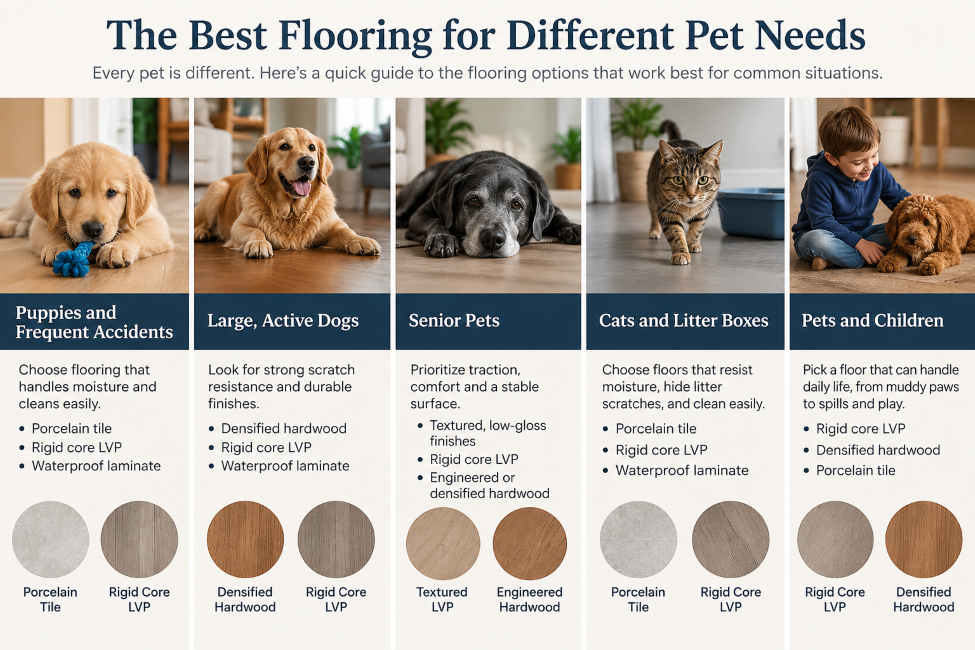
Puppies and House-Training
Accidents are the main concern. Porcelain tile and rigid core LVP are the safest choices. If you want real wood, densified hardwood offers more protection than traditional hardwood, as long as you clean up quickly.
Large, Active Dogs
Big dogs bring both scratches and impact. Look for strong dent resistance and scratch resistance. Densified hardwood and rigid core LVP both perform well here. Keeping nails trimmed helps any floor.
Senior Pets
Older dogs often struggle to get up on slick surfaces. Traction and comfort matter more than hardness. Choose textured, low-gloss surfaces and avoid polished tile. An attached pad adds cushioning, and hallway runners provide extra grip.
Cats
Even though cats are generally smaller than dogs, don’t assume cats are easy on floors. Dogs scuff a surface with blunt nails. Cats dig in. Their claws are sharp, needle-like points, and they grip hard when cats sprint, pounce, or launch off furniture. On softer woods like pine, that leaves gouges, not just surface marks.
Cats also bring moisture problems: hairballs, vomit, litter tracked from the box, and the occasional missed litter box. And cat urine is in a class of its own. It’s more concentrated than dog urine, and it smells strong and stubborn. Once it soaks into seams or the subfloor, the odor can be nearly impossible to remove. Worse, lingering scent can draw a cat back to the same spot.
Where cats run and play, choose a hard surface. Densified hardwood makes a striking difference here, because densified pine is far harder than ordinary pine. Near the litter box and feeding area, a moisture-resistant floor is worth it, even if the rest of the house is hardwood.
Pets and Kids
Households with both deal with spills, dropped toys, muddy feet, and all kinds of accidents. Rigid core LVP handles moisture and dents. Densified hardwood brings real wood the same toughness.
Design Choices That Hide Pet Wear
Every floor in a pet household will show some wear. Smart design choices keep it from standing out.
- Color: Mid-tone floors hide both light pet hair and dark dirt. Very dark and very light floors show everything.
- Gloss: Low-gloss and matte finishes hide scratches and paw prints better than high-gloss finishes.
- Texture: Wire-brushed, hand-scraped, and embossed surfaces disguise small marks and give paws more grip.
- Grain and variation: Floors with natural grain patterns and plank-to-plank color variation blend minor wear into the overall look.
“A scratch stands out because it catches light differently from the surface around it. Texture, grain movement, and a matte finish break up that reflection. The wear is still there, but your eye reads it as part of the floor’s character.”
— Andrea Flint, Senior Product Designer, Residential Wood, AHF
How to Choose the Right Floor for Your Home
Start with your biggest worry, then match the floor to it:
- Frequent accidents: porcelain tile or rigid core LVP
- Real wood with dogs: densified hardwood
- A senior pet that slips: textured, low-gloss vinyl with an attached pad, or matte hardwood with runners
- Scratch resistance with a wood look: waterproof laminate or rigid core LVP
- Long-term character and refinishing: solid or engineered hardwood, with calm, house-trained pets
Many homes don’t need one floor everywhere. Tile or rigid core in the kitchen, mudroom, and near the litter box can sit alongside wood in living spaces.
Frequently Asked Questions About Pet-Proof Flooring
Will Dog Pee Hurt LVP Flooring?
Not the planks themselves, if the floor is waterproof. Urine left to sit can still reach the seams and subfloor, where it can cause lasting odor. Clean accidents up promptly.
Can Dog Nails Scratch Vinyl Plank Flooring?
Yes. Any floor can show scratches. A thicker wear layer and a durable coating reduce them. Pet owners should choose resilient flooring with a wear layer of at least 20 mil and keep nails trimmed.
Is Laminate or LVP Better for Pets?
Both resist scratches well. Rigid core LVP is the safer choice for accidents because it won’t swell when wet. Laminate only makes sense for pet owners if it’s rated waterproof.
What Flooring Is Best for a Kitchen With Dogs?
Kitchens combine water bowls, spills, and heavy traffic. Porcelain tile and rigid core LVP handle moisture best. A mat under the water bowl helps on any floor.
Is Hardwood a Bad Idea if You Have Dogs?
Not necessarily. Harder species, matte finishes, and textured surfaces all help. Densified hardwood closes much of the scratch-resistance gap between real wood and rigid core vinyl.
Find the Best Flooring for Your Pets and Your Home
The best flooring for pets isn’t necessarily the hardest, the most waterproof, or the most expensive. It’s the floor that fits your household. A family with energetic dogs may prioritize scratch resistance. Someone with an aging pet may care more about traction and comfort. And you don’t have to sacrifice beauty for durability just because you share your home with animals.
Robbins Flooring offers options for every situation, from traditional solid and engineered hardwood to densified hardwood, rigid core luxury vinyl, and porcelain tile. Each brings different advantages. Choose flooring that works for your pets without compromising the look you want for your home.
Explore our flooring collections and visit a Robbins retailer near you to find the right fit for everyone who calls your house home.