
Rigid Core Vinyl Plank Flooring: Waterproof Wood Look
November 23, 2026
For decades, the rooms you loved most were often the rooms where hardwood made the least sense. Kitchens. Bathrooms. Basements. Laundry rooms.
Rigid core vinyl plank flooring changes that math. It delivers convincing wood visuals with a dense, stable core that shrugs off moisture that would ruin traditional wood floors.
Why Has Rigid Core Vinyl Flooring Become So Popular?
Because it solves several problems at once.
Rigid core delivers waterproof performance, realistic wood visuals, click-lock installation, and greater resistance to dents and dimensional changes than the flexible vinyl that came before it. Homeowners no longer have to choose between one and the other.
The market reflects that. Mordor Intelligence reports that rigid-core LVT, primarily SPC and WPC products, accounted for 74.81% of the luxury vinyl tile category in 2025 and projects that the segment will grow at 9.31% annually through 2031.
“Homeowners want flooring that can stand up to everyday life. That means kids, pets, spills, dropped objects, and heavy furniture. Rigid core is engineered to handle those demands while also providing the waterproof performance people increasingly expect. It gives homeowners the look of wood in places where traditional hardwood may not be the practical choice.”
— Olga Rivas, Senior Research Scientist, AHF
Rigid core is no longer a niche within vinyl flooring. It has become one of the category’s dominant constructions.
This growth also explains why core technology keeps advancing. When a category gets that large, manufacturers compete on engineering rather than price alone.
Key Takeaways
- Rigid core vinyl plank flooring is a type of luxury vinyl plank built around a dense, solid core layer. All rigid core is LVP. Not all LVP is rigid core.
- This construction makes the plank stiff and dimensionally stable, so it resists dents and handles temperature swings better than flexible vinyl.
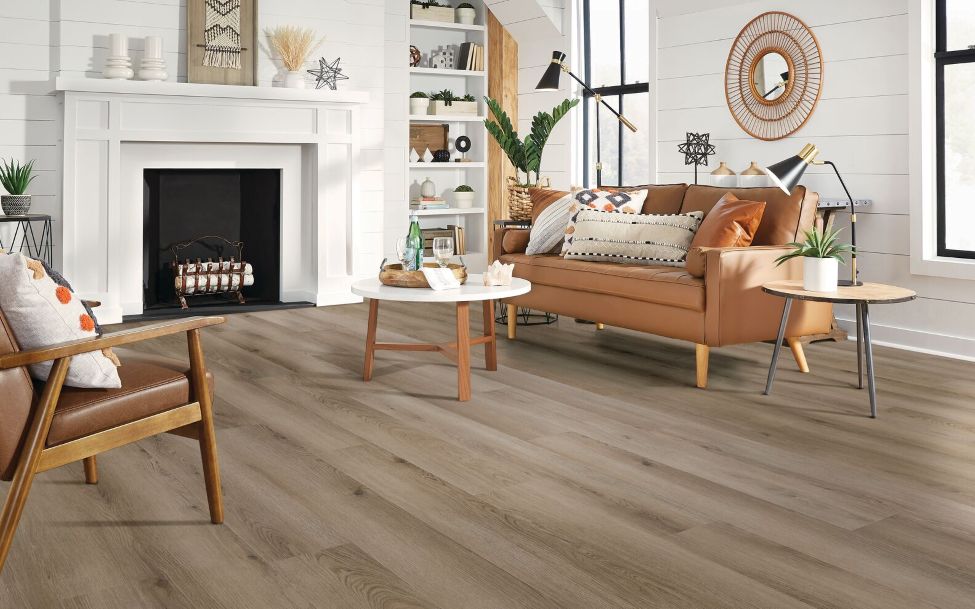
- Most rigid core flooring is waterproof. For example, Robbins® Daybreak™ HDPC® Rigid Core is rated 100% waterproof, opening up wood looks for kitchens, bathrooms, basements, and laundry rooms.
- Rigid core comes in three types: WPC (wood-polymer composite), SPC (stone-polymer composite), and now HDPC (high-density polymer core).
- The core protects the floor from below. The surface coating protects it from above. Evaluate both.
- Wear layer thickness is the spec most shoppers skip. For active households, look for 20 mil or more.
- Subfloor preparation matters. Rigid planks can bridge minor imperfections, but the subfloor must meet the manufacturer’s flatness requirements. Uneven surfaces can compromise the locking system over time.
What Is Rigid Core Vinyl Plank Flooring?
Rigid-core vinyl plank flooring is luxury vinyl plank (LVP) built around a dense, solid-core layer. This creates a stiff core rather than the flexible core of standard LVP. That construction gives rigid core flooring waterproof performance, dent resistance, and dimensional stability across temperature changes.
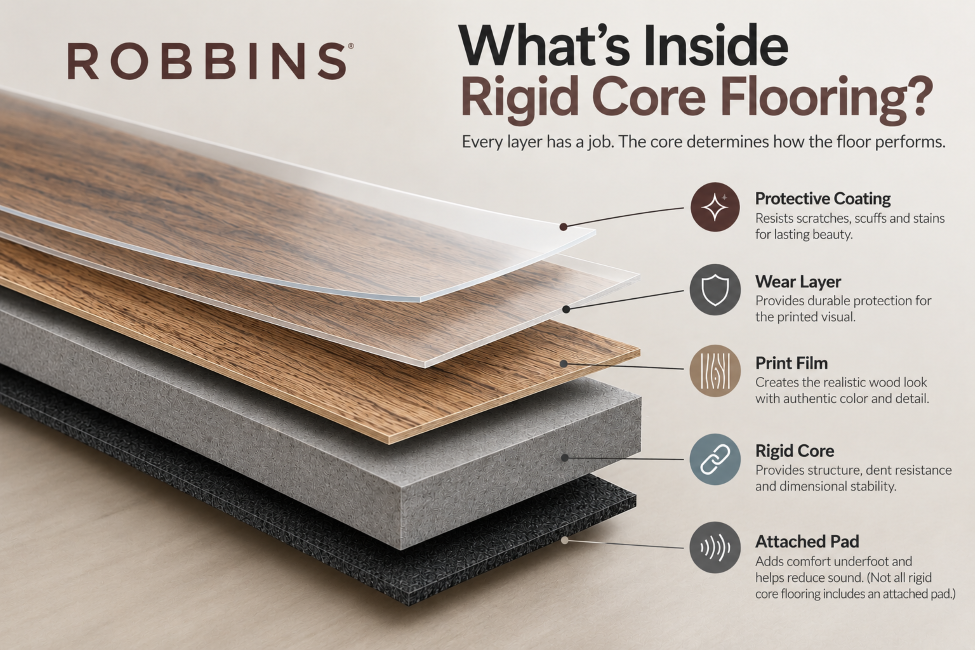
A rigid core plank is built in layers:
- A protective coating on top
- A wear layer
- The print film that carries the wood visual
- The core that does the structural work
- An attached pad on the bottom for sound and comfort (not all rigid core includes this)
Each layer has a job. The print film determines how the floor looks. The wear layer and coating determine how long it keeps looking that way. The core determines how the floor feels underfoot and how it performs over time.
Most rigid core installs as a floating floor with a click-lock system. The planks lock to each other rather than fastening to the subfloor. That’s why installation is faster than nail-down solid hardwood and why most residential applications require no glue or nails.
Is Rigid Core Flooring the Same as Luxury Vinyl Plank?
No, though people use the terms interchangeably, which causes real confusion in stores.
Rigid core is a construction used in luxury vinyl plank flooring. Every rigid core floor is LVP. Not every LVP is rigid core.
The difference is the core. Traditional flexible LVP uses a pliable PVC backing. You can bend a plank in your hands. It conforms to minor subfloor bumps. That sounds like an advantage until those bumps telegraph through the surface over time.
Rigid core uses a solid, dense core that doesn’t bend. That rigidity produces the benefits homeowners actually want:
- Better dent resistance under furniture
- A flatter finished floor
- Better dimensional stability in rooms that get hot or cold
It also introduces the one real tradeoff. A rigid plank cannot conform to an uneven subfloor. Flatness matters more, not less.
So when you see rigid core, rigid core LVP, or rigid core vinyl plank, they all describe the same thing. It’s luxury vinyl plank with a solid core instead of a flexible one.
Is Rigid Core Vinyl Plank Flooring Waterproof?
Most rigid-core vinyl plank flooring is waterproof, which is one of the main reasons the category has become so popular. Waterproof rigid-core flooring can withstand spills, splashes, and moisture without swelling, warping, or buckling, unlike traditional hardwood, which water can damage.
That opens the wood look to kitchens, bathrooms, laundry rooms, and basements where moisture can make traditional hardwood impractical.
One important distinction. A waterproof floor is not the same as a waterproof room. The planks themselves resist water. Water that runs past the perimeter, sits against baseboards for days, or rises through a wet subfloor can still cause problems beneath the floor. A waterproof product protects the flooring. It doesn’t substitute for fixing a leak or addressing a moisture source in a basement.
Waterproof claims also carry warranty conditions covering installation, maintenance, and standing water. For glue-down installations, manufacturers typically require their recommended adhesive to ensure full coverage. Read the warranty before you buy, not after.
What Are the Three Types of Rigid Core Flooring?
Most flooring guides describe two rigid core constructions. There are now three.
WPC Rigid Core Flooring
WPC stands for wood-polymer composite. The core combines wood flour or wood fiber with plastic composite and a foaming agent.
That foaming agent is the point. It makes WPC lighter and slightly softer than other rigid cores. That gives it a warmer, more forgiving feel underfoot and a quieter sound. WPC planks are typically thicker than comparable SPC.
Best for: bedrooms, living rooms, and spaces where comfort and sound matter more than maximum dent resistance.
Learn more about WPC flooring with this comprehensive guide.
SPC Rigid Core Flooring
SPC stands for stone-polymer composite. The core combines limestone powder with PVC and stabilizers.
Limestone makes SPC denser and more rigid than WPC. That density translates directly into better indent resistance and dimensional stability in rooms with temperature swings. SPC planks are usually thinner than WPC while delivering comparable performance, which helps with transitions and door clearances.
Best for: kitchens, entryways, high-traffic areas, and homes with heavy furniture.
HDPC® Rigid Core Flooring
HDPC stands for high-density polymer core, a patented technology from AHF, the manufacturer behind Robbins.
WPC and SPC both borrow density from a filler material — wood fiber in one case, limestone in the other. HDPC takes a different approach, engineering density into the polymer core itself. Robbins describes the result as heavier, denser planks with best-in-class indent resistance. The flooring also includes a robust locking system for strength and stability.
The performance claims are specific. Robbins Daybreak rigid core vinyl plank flooring requires no acclimation before installation. It withstands temperatures from 0°F to 200°F, making it suitable for three-season rooms and spaces with heavy direct sunlight.
Why Surface Protection Matters
Homeowners shopping for rigid core flooring often focus only on the core. That’s half the floor.
The core protects your floor from below. It handles compression, indentation, subfloor conditions, and temperature movement. The surface coating protects your floor from above. It handles scratches, scuffs, stains, and everything your household does on a Tuesday.
A dense core with a weak coating will hold its shape while looking worn. A tough coating over a soft core will look fine until a furniture leg leaves a permanent dimple.
Daybreak features Diamond 10® Technology taken from the long-standing resilient brand Armstrong Flooring®. The technology delivers the scratch-, stain-, and scuff-resistance commercial floors need to withstand daily traffic. For residential applications, that gives Daybreak surface protection that’s designed for considerably more demanding environments.
“Diamond 10 Technology has roots in AHF’s commercial flooring portfolio, where resistance to scratches, scuffs, and stains matters in demanding environments. Daybreak brings that surface-protection technology to a residential rigid core floor.”
— Olga Rivas, Senior Research Scientist, AHF
How Does HDPC® Compare With WPC and SPC?
| WPC | SPC | HDPC® | |
| Core construction | Wood-polymer composite | Stone-polymer composite | High-density polymer core |
| Waterproof | Yes* | Yes* | Yes* |
| Rigidity | Good | High | High |
| Comfort underfoot | Softer, warmer | Firmer | Cushioned with attached pad |
| Indent resistance | Good | Very good | Excellent |
| Dimensional stability | Good | Excellent | Rated 0°F–200°F** |
| Typical strength | Comfort and acoustics | Rigidity and durability | Density and indent resistance |
*Product dependent. Confirm with the manufacturer.
The useful way to read that table is as an evolution rather than a menu. WPC emphasized comfort. SPC pushed rigidity and dimensional stability further. HDPC takes another step, using high-density polymer construction to increase density and indent resistance while maintaining underfoot comfort through the attached pad.
Does Rigid Core Flooring Really Look Like Hardwood?
Good rigid core is convincing. Cheap rigid core is not, and the difference comes down to specifics you can evaluate in the store.
Print Quality
High-definition photographic printing captures the grain, knots, and color variations of real wood. Look closely at the grain. It should look like wood, not a wood pattern.
Texture
The best products emboss the surface so the texture aligns with the printed grain. When you run your hand across the plank, you should feel what you see.
Plank Dimensions
Wider and longer planks read as more authentic because real hardwood boards are not narrow and short. A 9-inch-wide, 60-inch plank looks far more like wood than a 5-inch strip.
Pattern Repetition
Every printed floor repeats eventually. More unique plank faces mean fewer visible twins across a room. Ask how many.
Edge Detail
Micro-beveled edges and ends define each plank the way real boards separate. Without them, a floor can read as a continuous sheet.
Gloss
This is what usually gives vinyl away. Real wood floors are rarely shiny. Low gloss and matte finishes look more like wood and hide scuffs better.
Robbins builds Daybreak in oak, white oak, hickory, maple, and walnut visuals with micro-beveled edges and ends, low gloss, and varied board-to-board character.
Where Can You Install Rigid Core Vinyl Plank Flooring?
Almost anywhere inside your home, including rooms where hardwood is not a practical option. This means interior spaces. Rigid core is not an exterior flooring product. Saunas, unenclosed porches, and similar applications are not covered under the typical warranty.
Inside your home, however, rigid core vinyl plank flooring does fit anywhere:
- Kitchens — spills, dropped cookware, and heavy appliance traffic
- Bathrooms — moisture, humidity, and standing water
- Basements — below-grade installation where hardwood typically cannot go
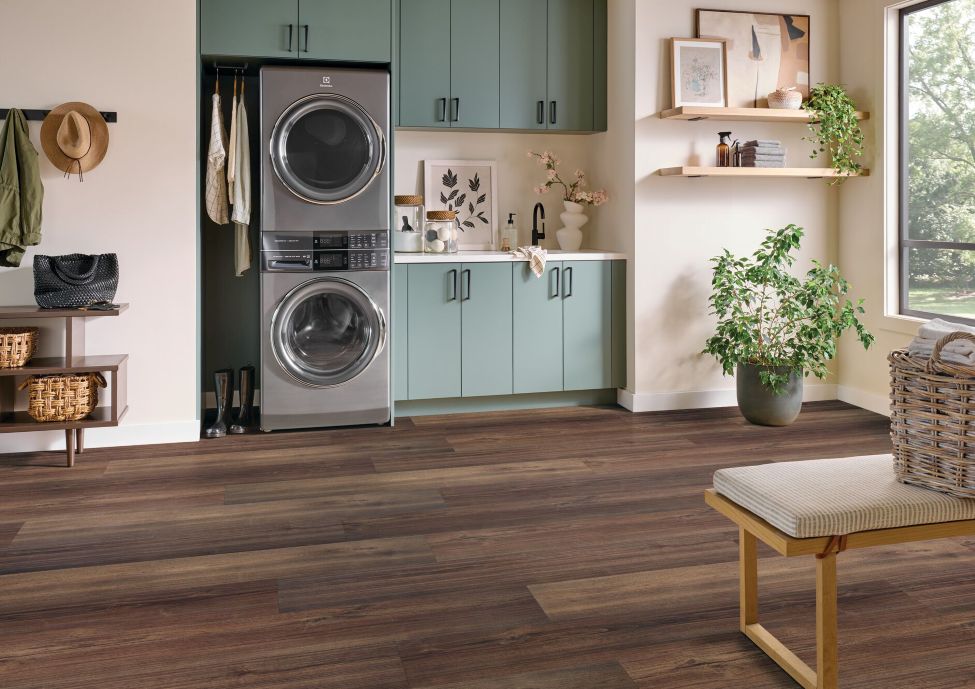
- Laundry rooms — appliance leaks and constant humidity
- Living and family rooms — high traffic with wood visuals intact
- Bedrooms — comfort and sound control
- Entryways and mudrooms — grit, salt, and wet shoes
- Home offices — rolling chair traffic
- Three-season rooms — wide temperature swings
Check the installation instructions before using it in unusual applications.
Is Rigid Core Flooring Good for Pets and Kids?
It is one of the best choices available, for reasons that go beyond durability marketing.
Waterproof construction handles the accidents that come with both. The rigid core resists dents caused by heavy furniture and dropped objects. A quality surface coating resists claw scratches, though no floor is scratch-proof.
Sound matters more than most people anticipate. Hard floating floors can sound hollow underfoot. Running kids and dog nails amplify that. An attached pad helps, but not all brands offer it.
Daybreak includes a 1.0 mm attached pad on every plank for sound dampening and a cushioned feel. That makes it perfect for households with pets and children.
Even though rigid core is built to handle high traffic, it’s still worth a few practical considerations. Trim pet nails. Use felt pads under furniture legs. Put a mat at the door. Those three habits do more for a floor’s appearance than a marginal difference in wear-layer thickness.
What Are the Disadvantages of Rigid Core Flooring?
No flooring is without tradeoffs, and you should know them before you buy.
Subfloor Flatness Matters
This is the big one. Rigid planks don’t flex to accommodate dips or humps. An uneven subfloor can cause hollow spots. In severe cases, the locking joints can separate or break. Budget for floor prep.
It’s Not Hardwood
Visual technology has improved dramatically, but rigid core lacks the depth, variation, or feel of real wood. Some buyers care. Some do not.
It Can’t Be Refinished
You can sand and refinish hardwood multiple times over decades. When a rigid-core floor wears or gets damaged, you replace planks, not restore them. The good news is that Daybreak includes a limited lifetime residential warranty.
Quality Varies Enormously
The category spans budget imports and engineered products with patented core technology. Rigid core alone tells you almost nothing about quality.
Firmer Underfoot
Denser cores can feel harder than wood or carpet. An attached pad helps considerably.
What Should You Look for in the Best Rigid Core Flooring?
The best rigid core flooring isn’t determined by the name on the box. Look at the construction, performance, and features you can actually compare.
| What to Compare | What to Look For |
| Core construction | A dense, stable core engineered to resist dents and dimensional changes |
| Wear layer | 20 mil or greater for active households and heavy residential traffic |
| Surface protection | A coating designed to resist scratches, scuffs, and stains |
| Waterproof performance | Waterproof construction backed by the manufacturer’s warranty |
| Dimensional stability | A broad temperature tolerance, particularly for rooms with direct sunlight |
| Attached pad | Added comfort and sound reduction |
| Locking system | A strong connection designed to maintain tight joints |
| Visual realism | Realistic texture, edge detail, low pattern repetition, and natural-looking planks |
| Indoor air quality | GREENGUARD Gold or comparable third-party certification |
| Warranty | Strong residential and, where relevant, commercial coverage |
Daybreak™ Rigid Core Vinyl Plank Flooring
Robbins Daybreak takes rigid core construction a step further with AHF’s patented HDPC high-density polymer core. The denser construction delivers best-in-class indent resistance and dimensional stability while maintaining the waterproof performance that makes rigid core practical throughout the home.
Daybreak pairs that core with Diamond 10 Technology for added resistance to scratches, scuffs, and stains. It’s rated for temperatures from 0°F to 200°F, requires no acclimation, includes an attached pad, and is GREENGUARD Gold certified.
The collection is available in Select and Preferred constructions, with 20-mil and 22-mil wear layers and realistic oak, hickory, maple, walnut, and white oak visuals.
“Homeowners shouldn’t have to choose between the wood look they want and the performance their home requires. Daybreak was developed to give them both, with visuals designed for today’s interiors and technology built for the way families actually live.”
— Devon McGrorty, Marketing Manager, AHF
Frequently Asked Questions About Rigid Core Vinyl Plank Flooring
What does “rigid core” mean?
Rigid core refers to the dense, solid core layer inside the flooring plank. Unlike flexible luxury vinyl plank, rigid core flooring doesn’t bend or conform to the subfloor as easily. That added rigidity improves dent resistance and dimensional stability, helping the flooring maintain its shape under furniture, foot traffic, and temperature changes.
Is rigid core flooring any good?
Yes. Rigid core flooring combines waterproof performance, dimensional stability, dent resistance, and realistic wood visuals. Quality varies widely, so compare core construction, wear layer, surface protection, the locking system, and the warranty instead of relying solely on the rigid core label.
Is rigid core better than LVP?
Rigid core is a type of LVP, so neither is inherently better than the other. Compared with flexible LVP, rigid core generally provides better dent resistance and dimensional stability. Flexible LVP can be more forgiving over minor subfloor imperfections.
Do I need underlayment for rigid core vinyl flooring?
It depends on the product. Many rigid core floors include an attached pad and do not require separate underlayment. Other products may require or allow one. Always follow the manufacturer’s installation instructions. Adding an unapproved underlayment can affect the locking system or warranty.
What is the difference between WPC, SPC, and HDPC?
WPC uses a wood-polymer composite core for comfort and sound. SPC uses a stone-polymer composite core for rigidity and dent resistance. HDPC is a patented high-density polymer core engineered for density, dent resistance, and dimensional stability.
Is rigid core vinyl plank flooring waterproof?
Generally, rigid core vinyl plank flooring is waterproof. A waterproof floor is not the same as a waterproof room, so address moisture sources in basements and bathrooms.
What wear layer do I need for rigid core flooring?
Residential products commonly range from 12 to 20 mil. For homes with kids, pets, or heavy traffic, look for 20 mil or more.
Can rigid core flooring go in a basement?
Yes. You can install rigid core below grade, one of its main advantages over hardwood and laminate. Confirm subfloor moisture conditions first.