
Chevron vs. Herringbone: Which Pattern Is Right for You
Two iconic layouts. One timeless, one bold. Here’s how to tell them apart and how to choose.
April 6, 2026 | By Robbins® Flooring
Walk into a beautifully finished room, and your eye goes to the floor. Maybe it’s the warmth of the wood. Maybe it’s the way the pattern pulls you deeper into the space.
Either way, what’s underfoot shapes the entire feeling of a room. And two of the most popular patterns driving that effect right now are herringbone and chevron.
They look related at first glance. Both use a zigzag geometry. Both have deep historical roots. And both have found a new audience among homeowners and designers who want a floor that does more than cover a surface.
But they aren’t the same. And when you’re choosing between them, those differences matter.
Chevron vs Herringbone Quick AnswerHerringbone uses rectangular planks set at right angles in a broken zigzag pattern. Chevron uses planks cut at precise angles that meet in a continuous “V.” Both are premium flooring options. The right choice depends on your space, style, and budget.
|
What’s the Actual Difference Between Chevron and Herringbone Flooring?
The confusion between these two patterns is understandable. Both are geometric, both are diagonal, and both create a rhythm across the floor. But the mechanics are distinct.
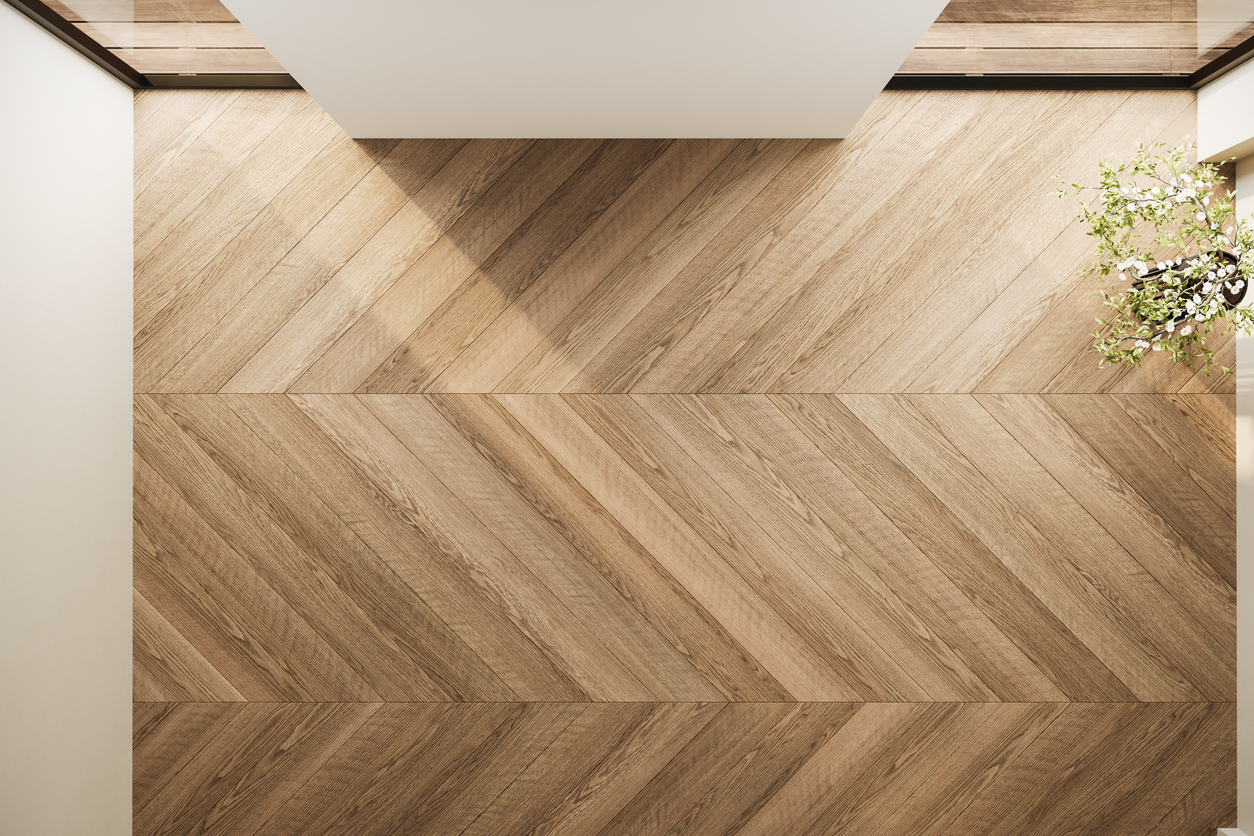
A herringbone pattern creates a dynamic, high-end visual impact that makes spaces appear larger and more luxurious, thanks to its distinct diagonal, interlocking V-shape.
What is Herringbone Pattern Flooring?
Herringbone uses standard rectangular planks installed at 90-degree angles to one another. Each plank connects to the next in a broken, staggered zigzag. The result looks a bit like the bones of a fish, which is exactly where the name comes from.
The pattern dates back to Roman road construction and appeared throughout European palace interiors for centuries. It has never really gone out of fashion, which tells you something about its staying power.
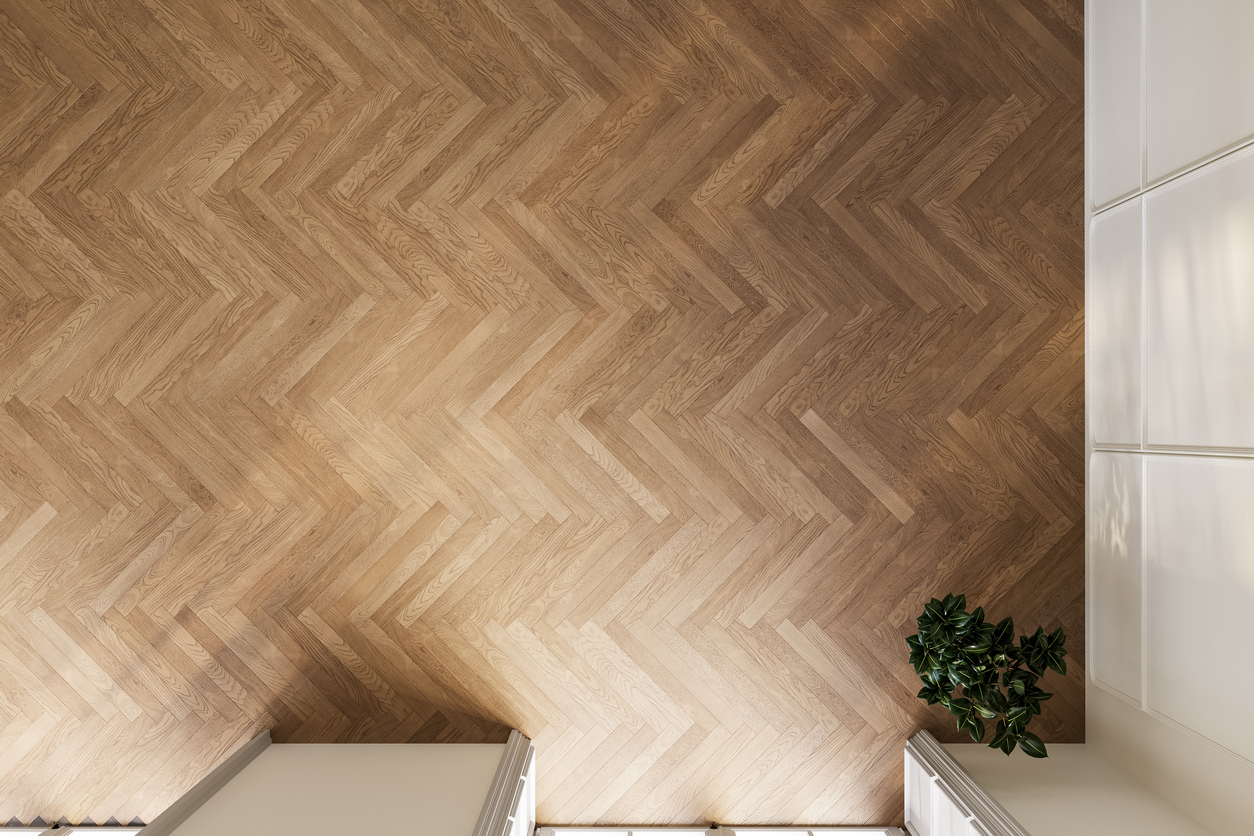
A chevron pattern creates a dramatic, modern visual impact and is often used to make spaces feel larger, taller, or more luxurious.
What is Chevron Pattern Flooring?
Chevron flooring requires planks that are cut at an angle on each end, typically 45 degrees. When two planks meet, they form a perfect point. That creates a continuous, unbroken “V” pattern that advances across the floor with geometric precision.
Because the planks must be cut to spec, chevron is almost always a custom or specialty order. There’s no “good enough” with the alignment; the points either match or they don’t.
“Herringbone gives you that sense of history and movement. Chevron is more architectural. It has a stronger, more directed energy that really suits modern interiors.”
— Katie Gluibizzi, Senior Designer, AHF Products
Chevron and Herringbone: A Side-by-Side Comparison
| Feature | Chevron | Herringbone |
| Pattern | Continuous “V” shape | Broken zigzag pattern |
| Plank Style | Angled cuts | Rectangular planks |
| Look | Modern, clean, bold | Classic, textured, versatile |
| Room Impact | Can make spaces feel larger | Adds depth and movement |
| Installation | More complex | Complex, but slightly simpler |
| Cost | Higher | Moderate to high |
| Best For | Modern, open spaces | Traditional or flexible designs |
What Is the Cost Difference Between Chevron and Herringbone Flooring?
Both patterns cost more to install than a standard straight or diagonal plank floor. That’s simply the reality of patterned hardwood. But they don’t cost the same amount.
Chevron flooring is generally 10–30% more expensive than herringbone, for a few reasons:
- Planks must be precision-cut at matching angles before installation begins
- Alignment is unforgiving, as the pointed joints must meet exactly, or the pattern breaks down
- Material waste runs 15–20% or more, compared to 10–15% for herringbone
- Labor costs are higher because the skill and time required are greater
Herringbone isn’t inexpensive, as it’s still a premium installation. But because it uses standard rectangular planks and the layout is more forgiving at the borders, it comes in at a lower overall cost in most projects.
The difference comes down to precision, waste, and labor.
“We always tell clients to think of Chevron as a long-term investment in the room. It’s not just flooring. It becomes the design feature of the space.”
— Devon McGrorty, Marketing Manager, AHF Products
Which Pattern Works in Which Room?
Pattern selection isn’t just about personal taste. It’s about how the pattern interacts with the dimensions and function of the space.
The best pattern often depends on how you intend to use the room and how the layout interacts with the space.
Where to Use Herringbone Flooring
Herringbone’s strength is its flexibility. It works in a 200-square-foot bedroom and a 2,000-square-foot great room. It reads as traditional in a Victorian brownstone and completely at home in a transitional new build.
Use a herringbone pattern in:
- Entryways and foyers where first impressions matter
- Living rooms where texture and warmth are the goal
- Dining rooms with traditional or transitional design
- Smaller spaces where the pattern adds interest without overwhelming
- Open-concept layouts that define zones without hard borders
Where to Use Chevron Flooring
The directional quality of the chevron creates a sense of length and movement, visually elongating a space. In a long hallway, that’s a powerful effect. In a small, square room, it can feel like too much.
Use a chevron pattern in:
- Large, open rooms where the directional pattern can fully develop
- Modern and contemporary interiors with clean architectural lines
- Hallways and corridors where the forward momentum of the “V” enhances flow
- Statement rooms are designed to make a deliberate design impact
| Design tip: Align your pattern with the longest wall in the room to maximize the sense of depth and length—whether you choose herringbone or chevron. |
Do Chevron and Herringbone Patterns Make a Room Look Bigger?
Yes, but differently.
Chevron’s continuous V-shape directs the eye forward and along the length of the room, making a space feel longer and more expansive. Interior designers often use it in hallways for exactly this reason.
Herringbone creates movement in multiple directions. It’s less about length and more about depth and dimension. Rather than stretching a space, it adds richness and visual interest that makes a room feel more considered and complete.
Neither will make a small room feel large on its own. But both can contribute to a perception of more space when combined with light colors, appropriate plank widths, and thoughtful installation direction.
Are Chevron and Herringbone Flooring Still in Style?
This question comes up constantly, and the answer is unambiguous: yes. Neither pattern is outdated.
Herringbone Bridges the Gap Between Classic and Contemporary
Herringbone is trending in 2026 precisely because it bridges the gap between classic and contemporary. It reads as heritage when paired with darker stains and period-appropriate trim.
Conversely, it’s fresh and modern when installed in white oak with a matte finish. That’s exactly what’s driving so much of its current popularity.
Chevron Delivers a Premium Look
Chevron is gaining ground in contemporary interiors that favor clean geometry and bold architectural statements. It’s scarcer than herringbone because it’s more complex to execute, so fewer floors feature it. However, it gives spaces a premium, differentiated feel.
Both patterns are part of a broader shift toward more expressive, design-forward residential interiors, where the floor is treated as a design element rather than a background.
“White oak in herringbone is having a genuine moment right now. I think it’s because it works across so many design sensibilities. It doesn’t feel trendy. It feels right.”
— Katie Gluibizzi, Senior Designer, AHF Products
Why Engineered Hardwood Makes Both Patterns More Practical
Patterned hardwood installation has historically been one of the more demanding flooring projects a homeowner could take on. Solid hardwood installations made it even more so, with its sensitivity to humidity changes and the complexity of acclimation.
Engineered hardwood has changed that calculus considerably. Because the planks are built with a layered core, they’re dimensionally more stable than solid wood.
In short, they handle the moisture fluctuations that come with real homes better. You can also install them over radiant heating systems, which solid wood typically cannot.
To better understand the difference between the two, read Solid vs. Engineered Hardwood – Is One Better?
Less Expansion and Contraction Keep the Joints More Stable
For herringbone and chevron patterns, this stability matters. The tighter the pattern and the more joints involved, the more any movement in the wood can affect alignment over time. Engineered hardwood reduces that risk significantly.
Pre-finished surfaces reduce installation time and eliminate the dust and fumes associated with on-site finishing. And because the veneer on quality engineered hardwood is genuine wood, it ages naturally and can often be refinished when needed.
Pros and Cons of Chevron vs Herringbone Flooring
If you’re weighing the decision, this breakdown makes it easier:
| Pattern | Pros | Cons |
| Chevron | Modern, high-end look
Creates a sense of space Strong visual impact |
Higher cost
More complex installation Less flexible across styles |
| Herringbone | Timeless design
Works in many spaces Adds texture and depth |
Higher installation cost
Requires careful layout Can feel busy in small spaces |
Which Should You Choose: Chevron or Herringbone?
If you’re still deciding, here’s the simplest way to look at it:
When to Choose a Herringbone Pattern
Choose herringbone if you want a floor that works beautifully in almost any room, carries a sense of history and depth, and adapts to both traditional and contemporary design. It’s the more versatile choice. It just so happens that European White Oak with a matte finish is also one of the most on-trend options available.
When to Choose a Chevron Pattern
Choose chevron if you’re working in a larger, more modern space and want a bold geometric statement that becomes the room’s defining feature. Budget for the additional cost and installation complexity. If you do that, you’ll enjoy a floor that relatively few homes have.
Either way, you’re choosing a floor that elevates the space above what a standard plank layout can offer. The pattern does the work. Your job is to decide which story you want it to tell.
If you’re leaning toward herringbone, modern engineered hardwood makes the pattern more practical than ever.
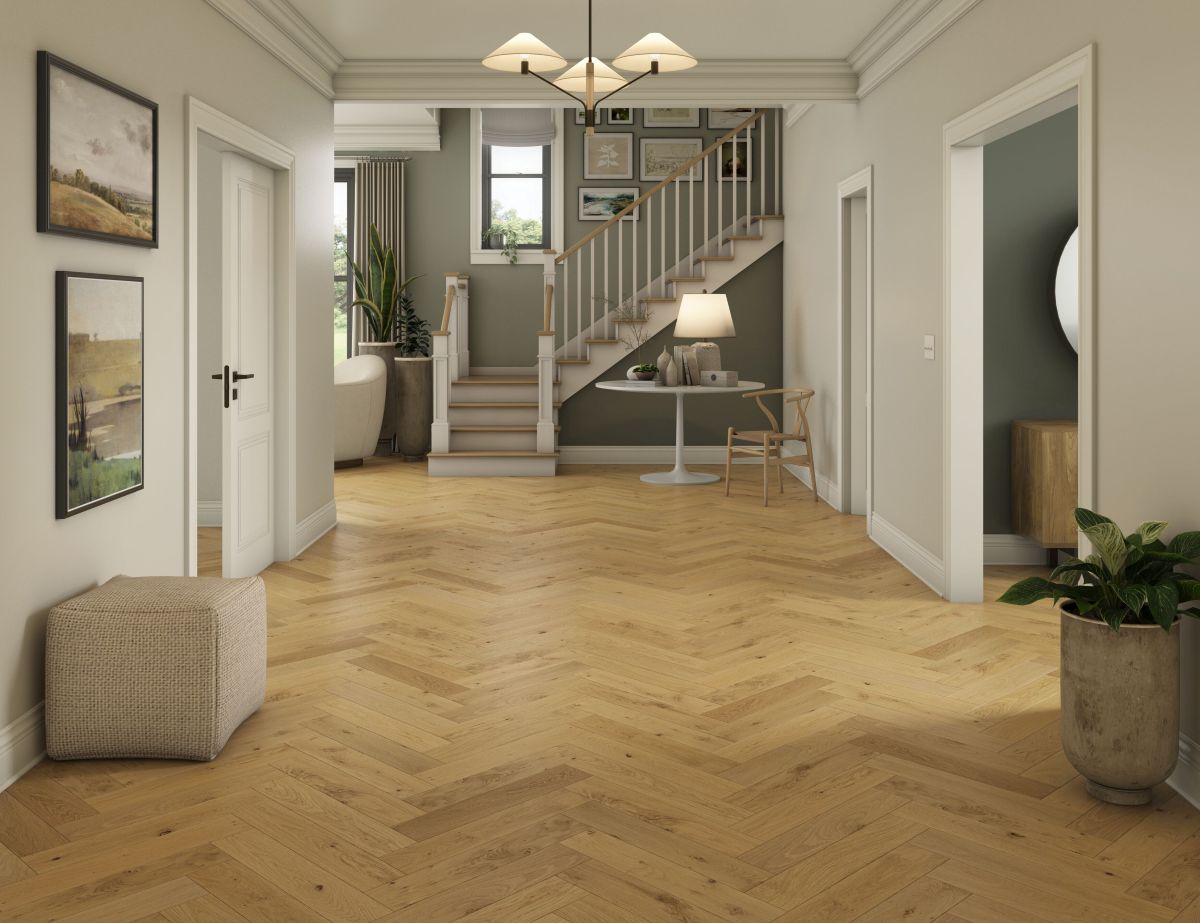
Available in 10 colors, Noble’s Way® is available in plank and herringbone patterns. The surface is wire-brushed for added texture.
Nobles Way®: Herringbone in European White Oak
Robbins® Nobles Way® European white oak flooring brings together everything that makes herringbone compelling in 2026:
- European White Oak
- Engineered hardwood construction
- Curated range of finishes that work across design styles
The collection is built for homeowners who want a pattern with history and character without compromising on the practical demands of a real home.
Engineered Hardwood That Reflects the Past with Today’s Performance
This collection features a high level of natural character and variation from plank to plank, so it’s crafted for those who value authenticity. The engineered hardwood construction can handle what everyday life throws at it:
- European White Oak for the subtle, distinctive grain that domestic oak lacks
- Engineered construction for stability across varying humidity conditions
- Low-gloss urethane finish with aluminum oxide to handle high-traffic spaces
- Wire-brushing creates a textured surface that hides scratches and dents
- Waterproof protection for up to 8 hours
You can explore Nobles Way on our website or find a Robbins retailer near you to see the collection in person.
Frequently Asked Questions About Chevron and Herringbone
Is herringbone the same as chevron?
No. Herringbone uses rectangular planks installed at right angles in a broken zigzag pattern. Chevron uses planks cut at matching angles so they meet in a continuous pointed “V.” They look related but are structurally different.
Is chevron more expensive than herringbone?
In most cases, yes. It’s typically 10–30% more, depending on the material, installer, and market. The precision cutting, higher material waste, and more demanding installation all contribute to the cost difference.
Is herringbone out of style?
Quite the opposite. It’s a popular addition to homes in 2026. Its resurgence in European White Oak with matte finishes shows how well it adapts to contemporary design.
Which pattern adds more home value?
Both can increase perceived home value when installed with quality materials and professional installation. Herringbone tends to appeal to a broader range of buyers; chevron has a more specific aesthetic that some buyers will value highly.
Can I install either pattern on my own?
Technically, yes. However, both patterns require careful planning, precise layout, and experience with diagonal installation. Most homeowners opt for professional installation, particularly for chevron, where alignment errors are difficult to correct after the fact.
Does chevron or herringbone flooring increase home value?
Both can increase perceived home value when installed professionally. Herringbone appeals to a broader range of buyers, while chevron offers a more distinctive, high-end look.