
What to Expect When You Visit a Flooring Retailer
Published August 18, 2026 | Robbins® Flooring Expert
You can buy a lamp in four minutes. But choosing flooring doesn’t work that way, and the first visit can surprise people who expected it to.
You’ll be asked about your house before anyone shows you a product. A flooring specialist will steer you off color for the first twenty minutes. And you probably won’t leave with a final price because the number that matters can’t be calculated until someone properly measures your floors.
None of that is a stall. Flooring isn’t a product you take off a shelf. It’s work performed in your house, on your subfloor, and, most importantly, in your conditions. The visit is designed to understand your home before anyone recommends a floor.
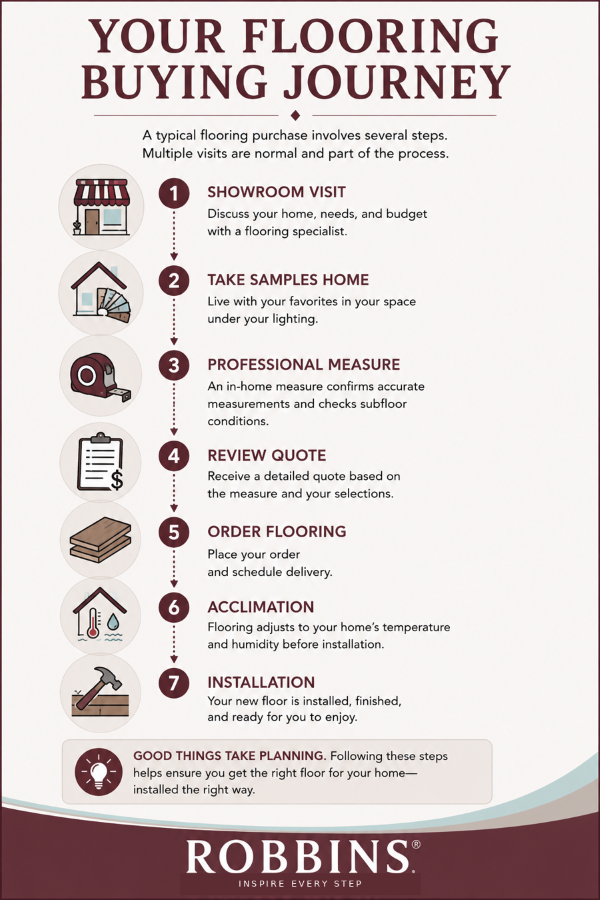
Here’s how the appointment usually unfolds.
The First Fifteen Minutes Are About Your House
Expect questions before recommendations. Which rooms? What’s on the floor now? Is the space above ground, ground level, or below? Wood subfloor or concrete slab? What about pets, kids, sunlight, and moisture? Are you planning to stay five years or twenty?
It can feel like a detour when your goal was to look at floors. It isn’t. Each answer eliminates products, and skipping this part is essentially guessing.
The best flooring consultation isn’t about finding the most beautiful floor. It’s about ruling out the ones your house won’t support.
What’s the Grade Level?
Grade level and subfloor do most of the work. Some products can’t go below grade. Some can’t go over concrete without a moisture barrier. A few can’t be installed over radiant heat at all. Those constraints rule out entire categories before anyone talks about how a floor looks. A good flooring specialist asks first, then shows.
If you don’t know your subfloor or your grade level, say so. They’ll work around it, and the in-home measure will confirm it.
Why They’re Steering You Away From Color
Most people arrive with a color in mind. Most specialists will gently set it aside for a while.
The reason is practical. Color is available in every category. Once you’ve narrowed to products that suit the room, you’ll still have plenty of shades to choose from. But if you pick the shade first and then discover the only product carrying it isn’t rated for your basement, you’re starting over.
You’ll get to color. It’s just the last filter, not the first.
You’ll Be Shown Fewer Options Than You Expected
A showroom carries hundreds of products. A good consultation puts three or four in front of you.
That narrowing is the service. If a specialist walks you down every aisle, you’ll leave overwhelmed and undecided. That’s how one visit becomes three. Expect to be shown a short list with reasons attached. This one because your basement needs it. This one because it’s rated for a household with dogs. This one if you want real wood and you’re willing to be careful.
You can absolutely ask to see more. But if the list stays short, that’s a sign the conversation is working.
Measuring Happens in Two Stages
Your own measurements get you a ballpark. The professional measure gets you a quote.
Bring your numbers to the first visit:
- Length and width of each room
- Closets and hallways noted separately
- Stair count if there are stairs
That’s enough for a specialist to estimate the materials and tell you whether your budget and product list overlap.
The professional measure comes later, usually after you’ve narrowed to a product. Someone comes to the house, measures accurately, and checks the subfloor’s condition and flatness. They test for moisture where it matters, and note doorways, transitions, and height clearances. That visit is what turns an estimate into a firm number.
Ask at the showroom whether the measure is free, whether it’s required before a binding quote, and whether scheduling it commits you to anything. Policies vary, and it’s a fair question.
Why the First Number Isn’t the Final Number
You’ll likely get a price range at the first visit, not a quote. That isn’t evasion. It’s what’s honestly knowable before anyone has seen the subfloor.
A complete estimate has more lines than most people expect:
- Flooring material, including a waste allowance
- Delivery
- Removing and disposing of the existing floor
- Moving furniture and appliances
- Subfloor inspection, repair, or leveling
- Moisture testing and any barrier required
- Underlayment
- Adhesive, fasteners, or grout
- Transitions, trim, moldings, and stair parts
- Installation labor
- Door and trim adjustments
Ask for it broken out by line. Two quotes are only comparable when you can see what’s in each one. A bid that comes in noticeably lower usually means something on that list isn’t included.
Tear-out is the most common surprise. Nobody knows what’s under an old floor until it’s up. Rot near windows, doors, and bathrooms turns up often enough that it’s worth asking how a mid-project discovery would be handled and priced.
The Sample Conversation
Near the end, you’ll be sent home with samples. This part has rules worth clarifying while you’re standing there.
Ask how many you can take, whether there’s a deposit, and how long you can keep them. Ask whether you can get a full plank instead of a small chip, as width and variation are almost impossible to judge from three inches. Ask whether there’s a larger display or an installed floor you can see somewhere.
Then take fewer than you’re tempted to. Three samples you actually live with beat eight that migrate around the kitchen table for a month.
At home, look at them in morning light, afternoon light, and under your lamps at night. Set them against your cabinets and trim. Showroom lighting is designed to make flooring look good. Your north-facing kitchen in November has no such agenda.
How the Visit Ends
A first appointment usually runs about an hour if you came prepared. It typically ends with:
- A short list of products that suit your rooms
- Samples to take home
- A price range rather than a firm quote
- A measure scheduled, or the information you need to schedule one
- A rough lead time and installation window
What it usually doesn’t end with is a signed order. That’s normal. Most people go home, live with the samples, and come back.
Before you leave, write down the product names, color names, and item numbers, and photograph the sample tags. Samples get separated from their labels within about a week, and “the medium brown one” is not a purchase order.
What the Second Visit Is For
The second appointment is shorter and more concrete. You’ve lived with the samples, ruled a couple out, and usually arrived at a favorite.
This visit confirms the product, reviews the measurement results and the firm quote, goes through warranty requirements, and schedules the installation. It’s also where you’d ask about production lots. Flooring is manufactured in batches, and connected rooms should come from the same one.
If the measure turned up something such as an uneven slab, elevated moisture, or a subfloor that needs work, here’s where it gets priced and where your timeline may shift.
The Overall Timeline
Every project differs, but the general shape:
- First visit: about an hour
- Samples at home: a few days to a couple of weeks
- Second visit and firm quote: shorter, often under an hour
- Professional measure: typically scheduled within a week or two
- Order and delivery: varies by product and stock status; in-stock colors move faster than special orders
- Acclimation: some products need time in the house before installation
- Installation: usually a few days, longer for stairs, complex layouts, or subfloor repair
From the first visit to the finished floor, several weeks are common. If you’re working toward a holiday, a move-in date, or a home sale, say so at the first appointment. It changes which products are realistic.
Learn more about what to expect on installation day.
What the Retailer Will Want From You
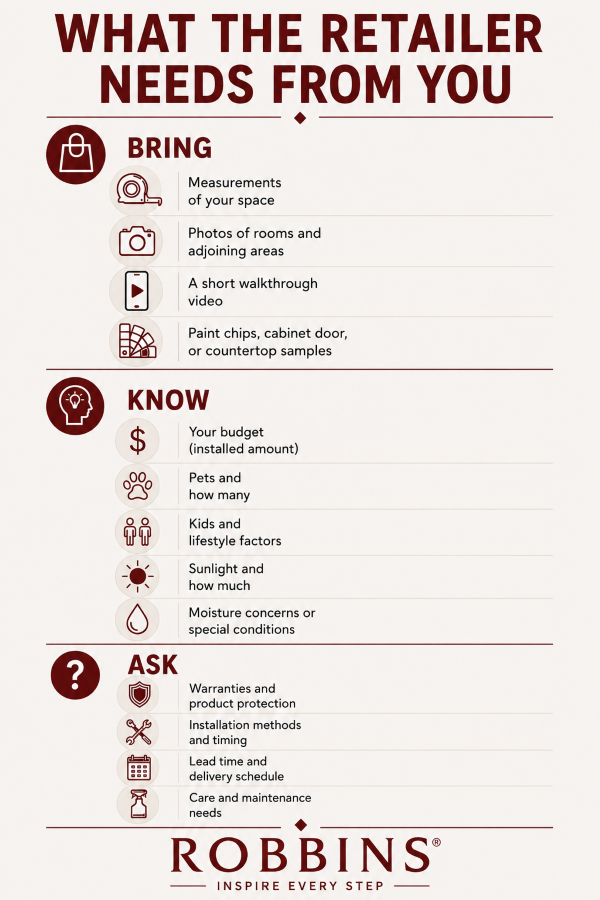
The consultation works both ways. Everything a specialist can tell you depends on what you can tell them. Most of this can be gathered in about an hour the night before your appointment.
Measurements
Length and width of every room getting flooring, with closets, alcoves, and hallways measured separately. Plus a stair count and tread width if stairs are involved. Measure wall to wall, not just the open floor. Flooring usually runs under toe kicks and appliances.
A rough sketch with the numbers written on each wall is worth more than a tidy list. It shows where rooms connect and where transitions land.
Photos and a Short Video
Wide shots of each room, then close-ups of everything the floor has to live beside:
- Cabinets
- Countertops
- Trim
- Stair parts
- Existing floor where it meets the space you’re changing
Remember to include the transitions between rooms, and the gap under doors and appliances. Both affect what can be installed. Then walk the space with your phone recording for thirty seconds. A video shows how light moves and how rooms connect in a way still images flatten out, and almost nobody brings one.
The Things That Have to Match
Bring a paint chip or wall swatch, a cabinet door or a daylight photo of one, a countertop offcut, and fabric from furniture that’s staying. Undertone clashes are obvious side by side and nearly impossible to judge from memory.
Your budget, stated as an installed number. “I have $3,500″ is ambiguous. Is that for material, or for a finished floor?
Say around $3,500 installed for these two rooms, and the specialist can work backward through material, labor, tear-out, prep, and trim to products that actually fit. Learning that your budget points to a different material than you had in mind is much better news in the first ten minutes than on the third visit.
Answers About How the Rooms Get Used
Pets and how many. Large dogs with long nails change recommendations more than almost anything else.
Kids, and how young. Rolling chairs, mobility equipment, or anything heavy on small wheels. Hours of direct sunlight. Moisture, including slabs, basements, bathrooms, and laundry rooms. Whether shoes come off at the door.
These do more to narrow the list than anything else you’ll say. Understating them doesn’t help you. Our guide on How to Choose Flooring for Your Home covers what heavy use actually does to a floor and which specifications matter most.
Your Timeline, and Any Hard Date
A holiday, a move-in, a closing. Lead times and acclimation requirements vary enough that a deadline genuinely changes which products are realistic to pursue.
Your Questions, Written Down
Ten questions are more than anyone remembers in a showroom. Worth covering:
- Waterproof or water-resistant and how the warranty defines the difference
- How it holds up to pets and daily traffic, and what the wear layer or finish is rated for
- Whether it’s approved for your subfloor and grade level
- How it’s installed — nail, glue, or float
- Whether a damaged board can be replaced, and whether the floor can be refinished
- Which cleaners are approved
- What the warranty excludes
- Whether professional installation is required for coverage to hold
- Lead time, and whether the color is in stock
- Whether the full order can come from one production lot
With that, the flooring specialist stops gathering information and starts recommending — which is the part you came for.
Ready to Start?
A flooring purchase is a consultation, not a checkout. You’re commissioning work in your home. The questions, the measure, and the multiple visits all exist to make sure what goes in is right for the rooms it’s going into.
Find a Robbins® retailer near you and start the conversation.
Frequently Asked Questions About a Flooring Store Visit
What happens during a visit to a flooring store?
A specialist asks about your rooms, subfloor, grade level, and household, then narrows hundreds of products to a short list that fits. You’ll review samples, discuss installation and budget, take samples home, and schedule a professional measure.
How long does a flooring consultation take?
About an hour for a first visit if you arrive with measurements and photos. Arriving without them typically turns one visit into two or three.
Will I get a price at my first visit to a flooring retailer?
Usually a range, not a firm quote. A binding number generally requires a professional in-home measure and a subfloor inspection. Prep work and repairs can’t be priced sight-unseen.
Do I need an appointment to visit a flooring showroom?
Walk-ins are usually welcome, but an appointment guarantees dedicated time with a specialist. Weekday mornings tend to be the quietest.
Why does the retailer ask so many questions before showing me flooring?
Grade level, subfloor type, moisture, and household use determine which products are even eligible. Answering those first prevents falling for a floor that can’t be installed in your room.
What is a professional flooring measure?
An in-home visit in which someone accurately measures and evaluates the subfloor’s condition and flatness. They test for moisture where needed and document transitions and height clearances. It converts an estimate into a firm quote.
How many visits does buying flooring usually take?
Two is typical. One to narrow products and take samples home. One to confirm the choice, review the quote, and schedule installation.
How long does the whole flooring process take?
Several weeks are common from the first visit to the finished floor, accounting for samples, measurements, ordering, delivery, acclimation, and installation. In-stock products move faster than special orders.