
Is LVP Flooring Right for Your Home?
You love the look of solid hardwood. You also have two dogs, a busy kitchen, and a basement you’d like to finish. That’s when luxury vinyl plank (LVP) usually comes up, along with a nagging question: is it a smart choice or a compromise?
LVP is right for your home when you want a wood look in rooms where water, pets, kids, or heavy traffic would work against real wood. It’s a less favorable choice when you want natural grain, a refinishable surface, and the appeal real wood brings to buyers.
To decide whether LVP is right for you, let’s start with what it is. Most homeowners have heard of it. Far fewer know why two LVP floors can perform very differently.
It’s a fast-growing category for practical reasons. Fortune Business Insights values the global LVP market at $8.81 billion in 2025 and projects it will reach $16.01 billion by 2034.
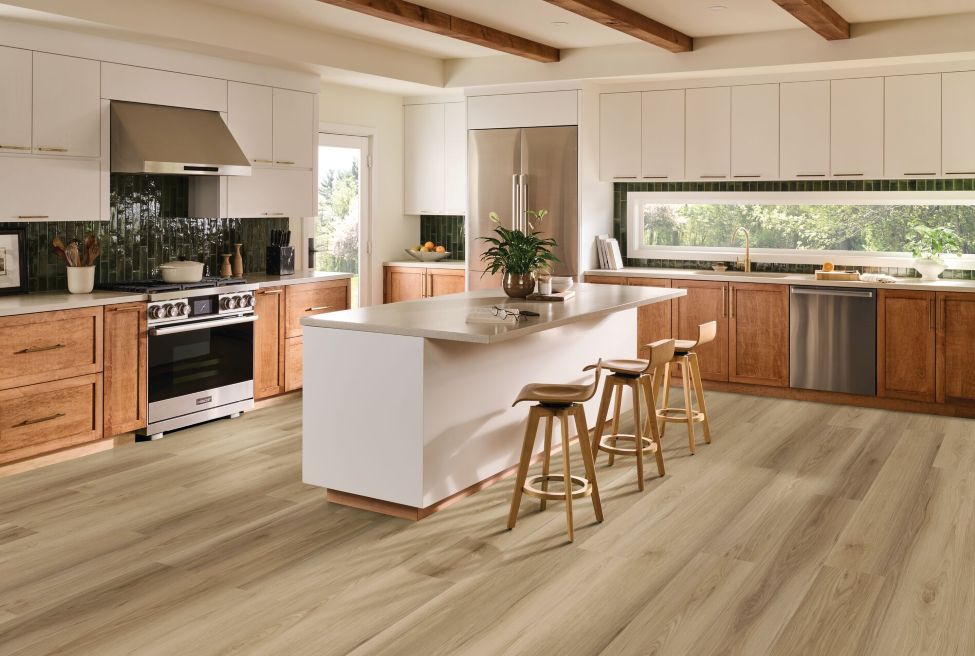
Key Takeaways
- LVP is a layered vinyl floor that uses a printed design layer under a clear wear layer to recreate the look of wood.
- Rigid core LVP is the larger and more versatile category. WPC, SPC, and HDPC® are three ways of building that core, each with different strengths.
- A waterproof plank won’t swell from water, but it doesn’t stop water from reaching the subfloor. Installation still matters.
- Plank thickness, wear layer, and surface coating measure different things. The wear layer protects against wear-through, the coating resists scratches, and the core resists dents.
- LVP typically costs $4 to $16 per square foot installed, compared with $11 to $25 for solid hardwood. Hardwood can be refinished; LVP can’t.
- LVP makes the most sense in kitchens, bathrooms, basements, and active households. Hardwood or porcelain tile can be the better investment elsewhere.
What Is Luxury Vinyl Plank Flooring?
Luxury vinyl plank is a resilient flooring made primarily from vinyl and cut into long, narrow planks that look like hardwood boards. It isn’t wood, and it isn’t trying to perform like wood. It delivers the appearance of hardwood with a different set of properties underneath.
The “luxury” originally set it apart from thin, basic sheet vinyl. Today’s LVP is a thicker, multilayer product with realistic wood visuals. Its square-and-rectangular cousin, luxury vinyl tile (LVT), uses the same construction to mimic stone and ceramic.
How Is LVP Made?
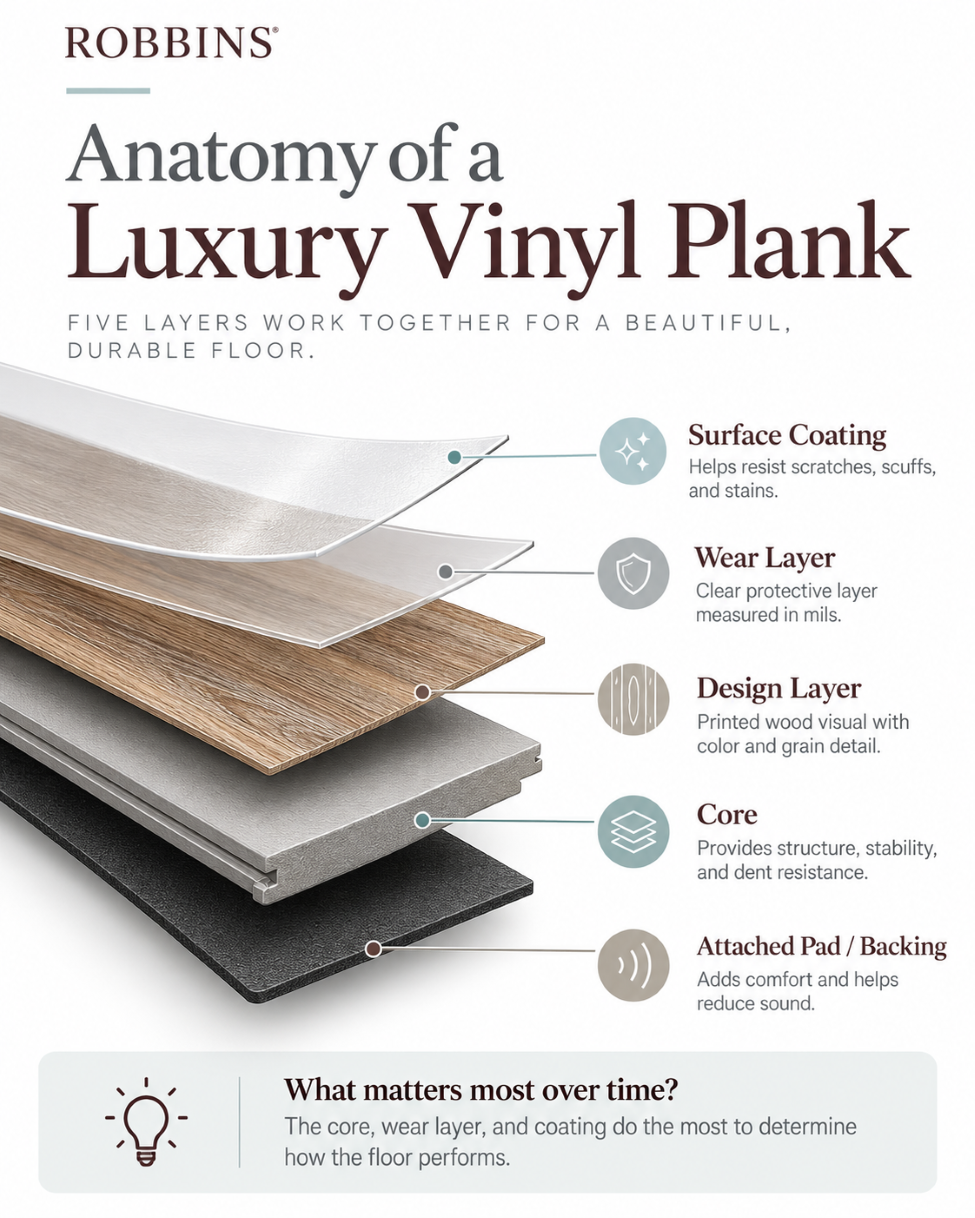
Every LVP plank is a stack of layers, and each layer has a job. Understanding them is the key to understanding why one LVP floor outperforms another.
- Surface coating: A protective top finish that adds scratch, scuff, and stain resistance.
- Wear layer: A clear layer, measured in mils (thousandths of an inch), that protects the design underneath from wearing through.
- Design layer: A high-resolution printed image that reproduces wood grain, color variation, and knots.
- Core: The structural heart of the plank. It determines rigidity, how the plank handles temperature changes, and its dent resistance.
- Backing or attached pad: Many products include an attached pad for comfort and sound reduction.
The wood look comes from the design layer, but realism depends on more than the print. Better products add texture that follows the printed grain, beveled edges, and longer, wider planks. They include enough variation that patterns don’t obviously repeat across a room. Take a closer look at how LVP actually compares to engineered hardwood.
The layers that most affect a floor’s long-term performance are the ones you can’t see: the core, the wear layer, and the coating. That’s where LVP products differ most.
Flexible vs. Rigid Core: The Two Types of LVP
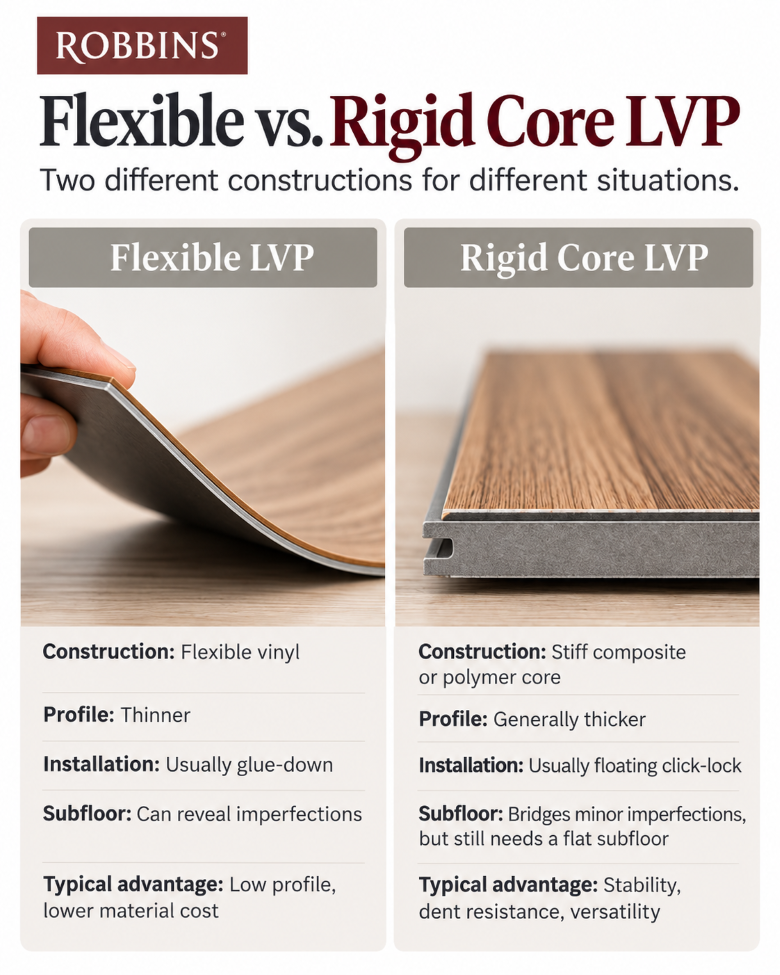
LVP isn’t one uniform product. The biggest difference is the core, which divides LVP into two families:
- Flexible
- Rigid core
They aren’t simply “good” or “better.” They’re different solutions for different situations.
Flexible LVP
It bends, is thinner, usually glues down, and follows the subfloor closely. That low profile is useful where door clearances or transitions to existing floors are tight. It often costs less. The trade-off is that a flexible plank shows what’s underneath it. Bumps, seams, and dips in the subfloor can telegraph through the surface.
Rigid Core LVP
It doesn’t bend. Its stiff core bridges minor subfloor imperfections, holds its shape through temperature changes, and resists indentation better. It typically installs as a floating click-lock floor. Fortune Business Insights identifies rigid core as the larger segment of the LVP market, citing its dimensional stability, indent resistance, and versatility.
| Flexible LVP | Rigid core LVP | |
| Construction | Flexible vinyl | Stiff composite or polymer core |
| Profile | Thinner | Generally thicker |
| Installation | Usually glue-down | Usually floating click-lock |
| Subfloor | Can reveal imperfections | Bridges minor imperfections, but still needs a flat subfloor |
| Typical advantage | Low profile, lower material cost | Stability, dent resistance, versatility |
WPC, SPC and HDPC®: Three Ways to Build a Rigid Core
Rigid core comes in three main constructions. Each takes a different approach to the core, with its own strengths.
- Wood-plastic composite (WPC) blends polymers with a foaming agent to create a core that feels softer and warmer underfoot and absorbs more sound. Homeowners often choose it for comfort.
- Stone-plastic composite (SPC) uses a dense, mineral-heavy core, typically limestone. It’s rigid and dent-resistant, and it’s the most common rigid core construction.
- High-density polymer core (HDPC) is a newer approach. It uses a dense polymer core engineered for indentation resistance and dimensional stability through temperature extremes. Robbins® Daybreak™ is one example of an HDPC rigid core floor.
None of the three is best for every application. The right construction depends on the room and what you want the floor to prioritize. Our guide to rigid core flooring compares them in more detail.
The Benefits of Luxury Vinyl Plank Flooring
LVP’s appeal comes down to one concept. It delivers the look of wood with properties wood doesn’t have. How much of each benefit you get, though, depends on how a specific product is built.
Waterproof Construction, and What It Really Means
Water resistance is the biggest reason homeowners consider LVP. It’s also the most misunderstood.
Wood is a natural material. It absorbs moisture, swells, and can cup or warp. Traditional laminate has a wood-fiber core that can swell when water gets into its seams.
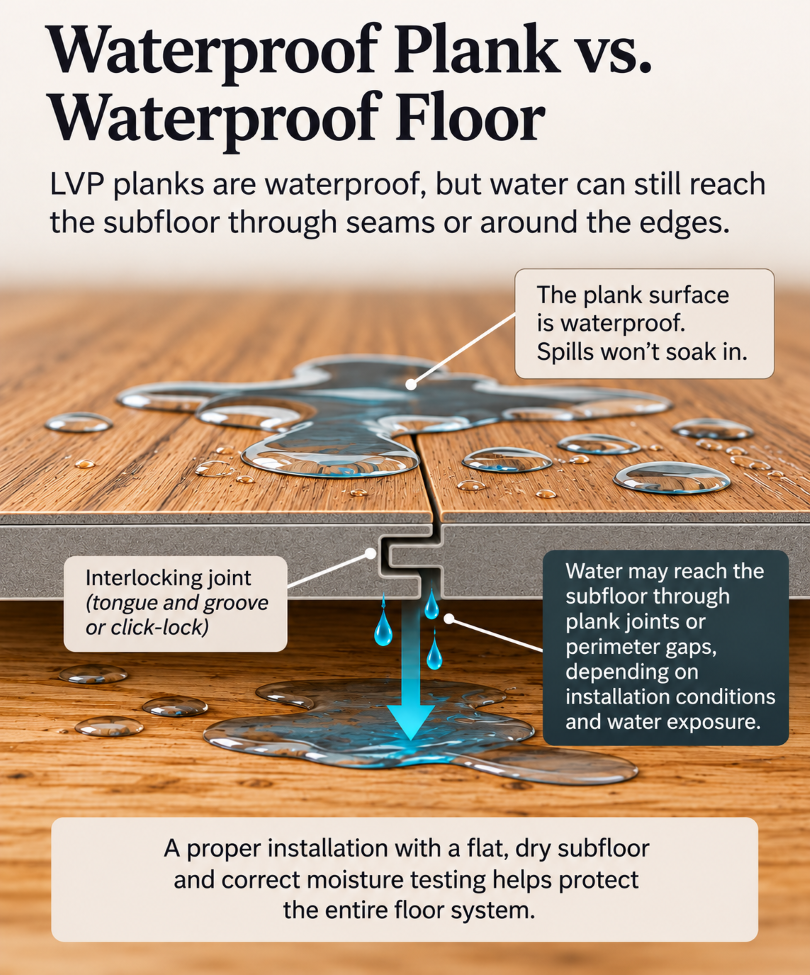
Vinyl doesn’t absorb water. A waterproof LVP plank won’t swell, buckle, or lose its integrity when it gets wet. That’s what makes LVP practical in rooms where wood is a risk.
But a waterproof plank isn’t a waterproof floor. Four things are worth separating:
- The plank itself. Waterproof construction means the plank can survive water exposure. That’s the claim, and it’s a real advantage.
- Seams and perimeter gaps. Floating floors need an expansion gap at the walls. Water from a spill left to sit, an overflowing tub, or a leaking appliance can travel through those gaps to the subfloor.
- Moisture from below. Concrete slabs, especially in basements, can push moisture up from underneath. That’s why manufacturers often require moisture testing and a vapor barrier over concrete.
- Flooding and standing water. No floor acts as a waterproofing barrier for the subfloor or the structure. Manufacturer warranties typically exclude damage from flooding and standing water.
“Most moisture problems I see under a vinyl floor have nothing to do with the plank. They start with an untested concrete slab or a dishwasher line that leaked slowly for months. The plank did its job. The water simply went around it.”
Olga Rivas, Senior Research Scientist, AHF
The practical test is the warranty. A product warranted as waterproof says so and spells out what’s covered. Always check the warranty.
Resistance to Everyday Wear
A quality LVP floor withstands the scratches, scuffs, spills, and dents that come with kids, pets, and busy rooms. In practice, that means a floor that looks newer longer in the hardest-used spaces. How well a particular product does that varies widely. That’s why the specifications in the next section are worth understanding before you buy.
A Realistic Wood Look
Printing and texturing have improved to the point that good LVP is hard to tell from wood at a glance. Long, wide planks, grain-following texture, and varied plank visuals make the biggest difference. A floor’s realism is one of the clearest signs of its overall quality.
Comfort, Quiet and Easy Care
Vinyl feels softer and warmer underfoot than ceramic or porcelain tile. That matters if you spend a lot of time standing in the kitchen. Attached pads help reduce noise. Day-to-day care is simple. Just sweep or vacuum, then damp-mop with a manufacturer-approved cleaner. LVP never needs sanding, refinishing, or waxing.
Installation Flexibility
Rigid core click-lock planks float over the subfloor without adhesive, often over existing hard floors. Floating floors can shorten installation time. Handy DIY homeowners can install it in simple rooms. Subfloor preparation still determines whether the floor performs, and it’s the most common reason LVP floors fail.
Value
LVP delivers a wood look at a lower installed cost than hardwood or tile in most projects. We’ll put real numbers on that below.
How Thickness, Wear Layers and Coatings Affect Performance
Homeowners tend to lump everything under one word: durability. But scratch resistance, wear-through, and dent resistance are three different performance factors. They come from three different parts of the plank. Most spec-sheet confusion starts there.
How Thick Should LVP Be?
LVP spec sheets list two thickness numbers, and it’s easy to mix them up. Overall thickness is measured in millimeters. Wear layer thickness is measured in mils. They tell you very different things.
A thicker plank isn’t automatically more durable. Is a 5 mm plank inferior to a 7 mm plank? Not necessarily. A 7 mm plank with a thin wear layer and a soft core can wear and dent faster than a 5 mm plank with a thick wear layer and a dense core.
Overall thickness matters most in a renovation for practical reasons:
- It affects how the new floor meets adjoining floors
- Whether doors clear it
- How it lines up with stair nosings and transitions
If you’re replacing a thick hardwood floor, a thinner plank can leave gaps under door jambs. Measure before you buy.
| Specification | What it affects | What to know |
| Overall thickness (mm) | Floor height, transitions, door clearance, feel underfoot | Thicker isn’t automatically more durable |
| Wear layer (mil) | Protection against wearing through the design | 12 mil can suit light use; 20 mil or more is a common choice for busy homes |
| Surface coating | Scratch, scuff, and stain resistance | A strong coating can matter more for scratches than wear layer thickness |
| Core construction and density | Dent resistance and stability through temperature changes | Material and density matter, not just thickness |
| Attached pad | Sound reduction and comfort | Use only the underlayment the manufacturer permits |
Wear Layers: Protection Against Wear-Through
The wear layer protects the printed design. Over years of foot traffic, a thin wear layer can wear down until the design shows damage. Thicker wear layers last longer.
Whether the difference matters depends on the room. In a guest bedroom that sees light use, 12 mil may be plenty. In a kitchen with three dogs, 20 mil or more is the safer choice.
Surface Coatings: The First Line Against Scratches
A thicker wear layer doesn’t automatically mean better scratch resistance. The surface coating takes the first hit from grit, pet nails, and chair legs. It largely determines how well a floor resists scratches, scuffs, and stains. Diamond 10® Technology, used on several AHF-branded floors like Armstrong Flooring® and Robbins®, is one example of a coating designed for that job.
The Core: Resistance to Dents
Dents come from concentrated weight such as a chair leg, a dropped pan, or a piano. Resisting them is the core’s job, not the wear layer’s. Dense, rigid cores resist indentation better than flexible vinyl, and constructions like SPC and HDPC are designed with that in mind.
“Thickness is the number people can see, so it’s the number they shop by. But a dent comes down to how much a material compresses under a concentrated load and whether it recovers. That depends on the core’s density and formulation. The same goes for heat. A stable core is what keeps planks from growing and shrinking at a patio door that bakes in the afternoon sun.”
Olga Rivas, Senior Research Scientist, AHF
How Much Does LVP Flooring Cost?
Cost often drives homeowners to look at LVP. On average, it costs less to install than hardwood or tile, but the ranges overlap more than many people expect.
| Flooring | Typical installed cost per sq. ft. |
| Luxury vinyl plank | $4–$16 |
| Laminate | $4–$14 |
| Engineered hardwood | $7–$20 |
| Solid hardwood | $11–$25 |
| Tile, including porcelain | $10–$50 |
National estimates for materials and labor from HomeGuide. Your price depends on the product, labor rates, subfloor preparation, and location.
The wide LVP range reflects how much products vary. A thin, flexible plank and a premium rigid-core floor with a thick wear layer sit at opposite ends. When you compare quotes, compare installed cost per square foot, including:
- Removal of the old floor
- Subfloor prep
- Underlayment
- Trim
- Transitions
Focus on Lifetime Value
The more interesting question isn’t which floor is cheapest today. It’s what each one costs over the floor’s life. Hardwood requires a larger upfront investment. But you can sand and refinish it, often several times, so you keep it for decades. LVP costs less to install and maintain, but you can’t renew it. When it wears out, you replace it.
That’s why cost, performance, and long-term value don’t always point to the same floor. LVP is often the better value in a basement or a busy kitchen, where moisture and wear would shorten hardwood’s life. Hardwood can be the better value in a dining room you expect to enjoy for twenty years.
Where LVP Makes Sense in Your Home
Those differences in core, wear layer, and waterproofing explain why LVP can be an excellent choice for one room and a weaker choice for another. A basement presents different challenges than a bedroom. A busy kitchen asks more of a floor than a dining room that’s used on holidays.
The Kitchen and the Spaces Around It
The kitchen is one of the toughest flooring decisions in a home. It’s the center of family activity. The floor has to look good while handling spilled drinks, muddy shoes, dropped utensils, and chairs that never stop moving.
Hardwood brings warmth, but everyday moisture at the sink and dishwasher is a long-term concern. Porcelain tile shrugs off water and wear, but it’s hard and cold for anyone who spends an hour at the counter. LVP sits between them: a wood look, waterproof planks, and a more forgiving surface underfoot.
The bigger payoff often comes in open floor plans. When the kitchen flows into the family room, LVP lets one continuous wood look run through both spaces, without a transition where wood would have to stop—one planning note. Floating floors need room to move, so install cabinets and islands on the subfloor, not on top of the floor.
Bathrooms and Laundry Rooms
Splashes, humidity, and wet bath mats are everyday conditions here, and waterproof planks are built for exactly that. The limits we covered earlier still apply. Overflowing tubs, running toilets, and leaking washers can put water under any floor, so perimeter sealing and quick cleanup matter. For shower surrounds and other areas designed to stay wet, porcelain tile is the better choice.
Basements
Basements are one of the strongest cases for rigid core LVP. Solid hardwood isn’t recommended below grade, though engineered hardwoods will work. Basements bring moisture, cooler temperatures, and concrete subfloors. Most rigid core products are approved for below-grade installation.
The key is what’s underneath. Test the concrete for moisture and use the vapor barrier the manufacturer requires. If the basement has a history of flooding, fix the water problem first.
Homes With Pets and Kids
Dog nails, water bowls, accidents, and toy trucks test the floor daily. The question isn’t whether the floor will see wear. It’s whether that wear will show. A strong surface coating, a 20 mil-or-thicker wear layer, and a dense core give LVP its best chance. No floor is scratch-proof. But for many families, it’s the difference between a floor they protect and a floor they live on. Our guide to the best flooring options for pets goes deeper.
“Lots of homeowners start out asking for hardwood. Then they tell you about the Labrador and the basement, and the conversation changes. What’s different now is how people feel about that. LVP used to be what you settled for when the budget ran out. Today, homeowners ask for it by name for the kitchen and basement, and the real debate is over the living room.”
Devon McGrorty, Marketing Manager, AHF
Sunrooms and Sun-Filled Rooms
Temperature swings and strong direct sunlight can cause flooring to expand, contract, and fade. These spaces have traditionally been a risk for vinyl. Some rigid core products, like Daybreak™, are now rated for wider temperature ranges and can be used in a sunroom. Check the product’s approved conditions before you buy, and use window coverings to reduce fading.
| Room | Why LVP fits | What to watch |
| Kitchen and open plans | Water resistance, comfort and one continuous look | Cabinets and islands go on the subfloor |
| Bathroom and laundry | Won’t swell from splashes and humidity | Perimeter sealing; porcelain for shower areas |
| Basement | Approved below grade where solid wood isn’t recommended | Moisture testing and a vapor barrier |
| Pets and kids | Stain, scratch, and dent resistance | Coating, 20+ mil wear layer and a dense core |
| Sunroom | Wood look in a bright, changeable space | Product’s temperature rating |
When LVP Isn’t the Best Choice
LVP can be an excellent floor, but it isn’t the right choice for every room or every homeowner. Knowing where it falls short lets you choose it with confidence, where it fits.
When You Want the Material, Not Just the Look
Some homeowners don’t want something that looks like wood. They want wood. Real hardwood has natural variation no print fully reproduces, and it ages with character rather than simply wearing out. In a living room, dining room, or primary bedroom, where water exposure is low, there’s little practical reason to give that up.
Hardwood also offers something LVP can’t: you can sand and refinish it. A deep gouge in LVP means replacing the plank. If you’re thinking in decades, renewing a worn hardwood floor matters.
When Dents Are the Worry, Not Water
For some families, the real objection to hardwood is that it dents. That doesn’t automatically point to LVP. Densified hardwood, such as Robbins Timber Legends™, is real wood engineered to resist dents. It’s worth a look if you want natural wood in an active household and the room doesn’t have a moisture problem.
When Tile Is the Tougher Answer
In shower areas, high-traffic entryways, or spaces where you want a stone or concrete look, porcelain tile is harder, more scratch-resistant, and waterproof. Wood-look porcelain offers a plank visual with tile’s toughness. The trade-offs are comfort and cost. Tile is harder and colder underfoot, and it takes longer to install.
When Resale Expectations Favor Hardwood
In some housing markets, buyers expect hardwood in the main living areas. LVP in a kitchen or basement rarely raises concerns. LVP throughout a home where comparable houses have hardwood might. If you plan to sell in the next few years, look at what’s in similar homes nearby.
When the Subfloor Needs Real Work
LVP needs a flat, clean, dry subfloor. Dips and humps can make planks flex at the joints, leading to clicking, hollow spots, or separation. None of that rules LVP out, but it belongs in the budget.
When Natural Materials Matter to You
LVP is made primarily from PVC. If you prefer natural materials, wood or porcelain is the better match. If indoor air quality is your concern, look for products with third-party low-emissions certification, such as GREENGUARD Gold.
If you’re still weighing those alternatives, our comprehensive guide to choosing flooring for your home compares how each material performs in durability, appearance, comfort, and long-term value.
Is LVP the Right Choice for Your Home?
LVP is right for your home when the room’s conditions matter more than the material itself. That’s often true in kitchens, bathrooms, basements, laundry rooms, and any space shared with pets and kids. It’s less often true in the quiet, dry rooms where hardwood has always done its best work.
That’s why the best answer is often “both.” Many homes put hardwood in the living and dining rooms and LVP where water and wear are part of daily life. You don’t have to force one floor to do every job.
What to Look for When You Shop
If LVP fits, choose the product the way you’d choose any floor: by how it’s built for the room it’s going in.
- Construction: Rigid core for most rooms, and especially for basements and uneven subfloors. Flexible LVP where a low profile matters most.
- Wear layer: 20 mil or more for kitchens, entryways, and homes with pets or kids.
- Surface coating: The strongest coating you can find if scratches are your main concern.
- Approved conditions: Confirm the product is approved for below-grade spaces, bathrooms, or temperature-variable rooms if you plan to use it there.
- Warranty: Read what “waterproof” covers, and what the residential warranty promises.
Some rigid core products are now engineered for conditions that used to rule vinyl out. For example, Robbins Daybreak combines an HDPC core with Diamond 10 Technology for surface protection. It’s rated for temperatures from 0°F to 200°F and needs no acclimation, which expands where it can be used, subject to installation requirements.
Match the Floor to Your Priorities
The right flooring choice starts with understanding what matters most to you. Do you want the warmth and character of natural wood? Can it handle water, pets, and everyday wear? Does it balance performance, appearance, and cost?
No single flooring material does everything equally well. Use the following guide to match your priorities with the options most likely to meet your needs.
| If this matters most | The better fit |
| A wood look that stands up to water and daily wear | Rigid core LVP |
| Real wood you can sand and refinish for decades | Solid or engineered hardwood |
| Real wood with more dent resistance | Densified hardwood |
| Maximum hardness and water resistance | Porcelain tile |
| Comfort and warmth underfoot | LVP, especially WPC rigid core |
| The lowest installed cost | LVP or laminate, compared on installed cost, not material price |
| Resale in a market that prizes hardwood | Hardwood in main living areas, LVP where water is a factor |
Choose Flooring That Fits the Way You Live
Luxury vinyl plank has earned its place in today’s homes because it offers a practical combination of appearance, durability, water resistance, and easy care. But understanding its advantages is just as important as recognizing where another flooring material might serve you better.
The best decision isn’t necessarily choosing one material throughout your home. It may mean enjoying the natural beauty of hardwood in your living areas while relying on LVP’s waterproof performance in your kitchen, bathrooms, or basement.
Ultimately, the right flooring looks the way you want, performs the way you need, and delivers lasting value for your investment.
Robbins offers luxury vinyl plank, hardwood, densified hardwood, and porcelain tile to help you find that balance. Explore our flooring collections or visit a Robbins retailer to compare your options in person.